When your child relapses, it can feel like gravity just changed.
You’re back to checking their eyes when they walk in. Back to sleepless nights and stomach knots. You’ve done therapy, made sacrifices, read every book—and here you are, staring at the ceiling wondering what else could possibly help.
If you’re the parent of a 20-year-old who just relapsed, you’re not alone. And you’re not failing. This isn’t the end of the road—it’s a turn. And for many families, the most helpful next step is a Partial Hospitalization Program.
Learn more about our Partial Hospitalization Program here.
What Is a Partial Hospitalization Program?
A Partial Hospitalization Program (PHP) is a structured, intensive treatment option that offers support during the day while allowing your child to return home in the evenings.
It’s not inpatient. It’s not just therapy.
PHP bridges the gap between full hospitalization and traditional outpatient care. It’s designed for people who are struggling with mental health or substance use challenges that require daily clinical support—but who don’t need round-the-clock supervision.
At Tal Behavioral Health, PHP typically includes:
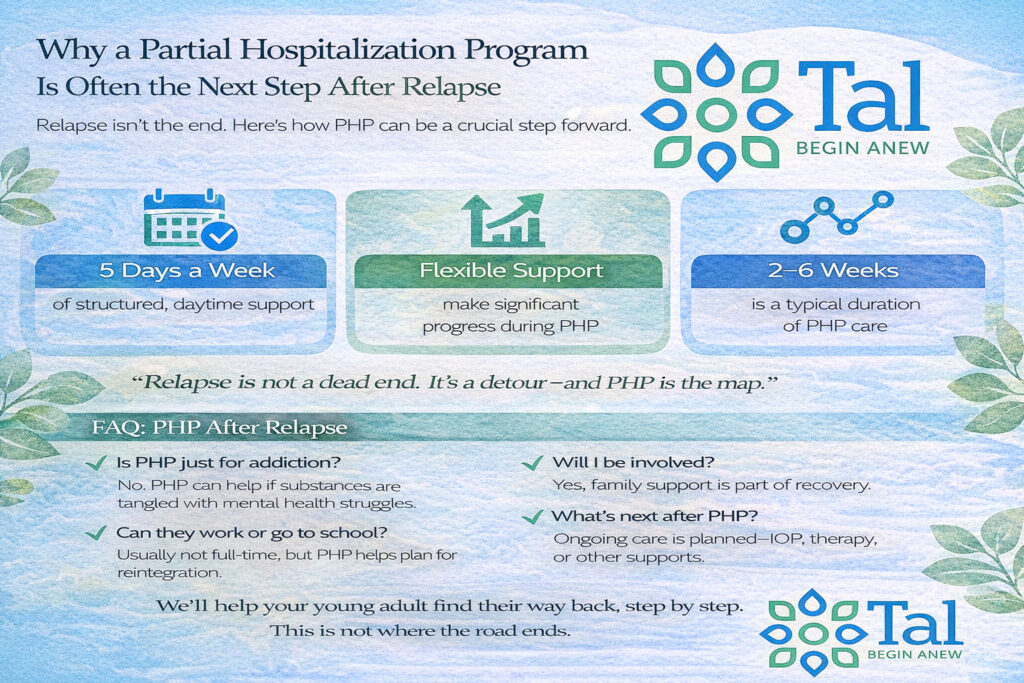
- 5 days a week of programming
- Group therapy, individual therapy, and psychiatric care
- Family support and coordination
- Life skills, emotional regulation, and relapse prevention
It’s the kind of environment where healing is possible—without removing your young adult from their life completely.
Why PHP Is Often the Right Next Step After Relapse
Relapse isn’t a moral failure. It’s a signal. A flare in the dark saying, “Something still hurts. Something still needs attention.”
PHP responds to that signal with structure and support.
Here’s why it helps:
- It removes isolation. Many relapses happen when someone is alone too often, or emotionally disconnected. PHP brings connection back into their days.
- It provides daily accountability. Seeing a team every day helps your child stay grounded, especially during vulnerable windows post-relapse.
- It digs deeper. Relapse usually isn’t about willpower. It’s about pain, patterns, and avoidance. PHP creates space to explore and interrupt those dynamics.
- It avoids full inpatient disruption. Your child doesn’t need to pack a bag. They still sleep in their own bed. That matters to young adults seeking some autonomy.
“But We Already Tried Treatment…”
If you’ve been through treatment before, you may be thinking: Why would this work when that didn’t?
That’s a fair question—and one we hear often.
But here’s the thing: it’s not always about starting over. It’s about starting differently.
Maybe the last program didn’t offer enough structure. Maybe your child wasn’t ready then but is open now. Maybe they outgrew what worked a year ago. Recovery isn’t one-size-fits-all—and it’s rarely a straight line.
PHP doesn’t erase what came before. It builds on it.
What Makes PHP Different from Weekly Therapy?
Weekly therapy can be incredibly helpful—but after a relapse, it’s often not enough.
Your child may need more time, more eyes on their progress, and more opportunities to process what’s really going on beneath the surface. That’s what PHP provides.
Key differences:
| Feature | Weekly Therapy | PHP |
|---|---|---|
| Frequency | 1x per week | 5x per week |
| Support Type | Individual only | Group, individual, family, psychiatric |
| Supervision | Low | Moderate |
| Focus | Talk therapy | Full clinical immersion |
When someone is vulnerable post-relapse, timing matters. Access to support every day can be the difference between staying stuck and moving forward.
You’re Not to Blame. You’re Allowed to Feel Heartbroken.
As a parent, it’s easy to shoulder the weight of everything. But relapse doesn’t mean you didn’t love them enough. It doesn’t mean you made a mistake.
It means your child is still struggling—and you’re still here trying. That’s love.
Your grief is real. So is your hope. PHP offers you both: the space to be sad and the structure to rebuild.
At Tal Behavioral Health, we work with families—not just clients. We help you understand what’s happening, what your role can be, and how to take care of yourself during this process.
Because you matter too.
What If They Don’t Want to Go?
This is one of the hardest parts. Watching your child struggle and refuse help can be heartbreaking.
But here’s something to remember: resistance doesn’t always mean rejection. Sometimes, they just need time, clarity, or the right framing.
PHP may feel less intimidating to your child than inpatient treatment. They keep their phone. They sleep at home. They don’t have to “go away”—they just have to show up.
And even if they’re not ready today, planting the seed matters.
Sometimes the door doesn’t swing open. Sometimes it cracks. And that’s where healing begins.
Local Support That Understands What You’re Facing
We know how hard it is to trust again—to believe that this time might actually help. But families in Cleveland, Shaker Heights, and Chagrin Falls have trusted us during some of their darkest moments. And we don’t take that lightly.
Our Partial Hospitalization Program is built for young adults who’ve relapsed—and for the families who love them.
Frequently Asked Questions About PHP After Relapse
Is PHP just for people with addiction?
Not at all. PHP is ideal for individuals dealing with complex mental health challenges, substance use, or both. Many young adults who struggle post-relapse also deal with anxiety, depression, trauma, or emotional dysregulation.
How long does PHP last?
Most programs last between 2–6 weeks, depending on your child’s needs and progress. We reassess weekly and build a transition plan together.
Will I be involved in their treatment?
Yes. Family involvement is a key part of recovery, especially for young adults. We offer family therapy and regular updates with your consent.
Can my child work or go to school while in PHP?
Usually not full-time. PHP is a daytime commitment—often 5–6 hours per day, Monday through Friday. That said, we help plan for school or work reintegration after discharge.
What happens after PHP?
We create a step-down plan that might include intensive outpatient (IOP), individual therapy, medication support, or alumni resources. Continuity of care is a top priority.
📞 Still breathing? That’s enough to start.
Call (216) 480-4860 or visit to learn more about our Partial Hospitalization Program services in Cleveland, Ohio. You’re not alone—and neither are they.