
For many people living with chronic pain, opioids begin as a legitimate medical treatment.
The medication reduces pain, makes daily activities more manageable, and improves quality of life. But after weeks, months, or even years of use, something unexpected can happen.
The pain returns.
The medication no longer seems to work as well.
A higher dose provides only temporary relief.
Sometimes, the pain feels even worse than it did before treatment began.
It is natural to assume that the underlying condition has progressed or that the body has simply become accustomed to the medication. While those explanations are sometimes correct, there is another possibility that many people have never heard of.
A condition known as opioid-induced hyperalgesia can actually make the nervous system more sensitive to pain over time. Instead of reducing discomfort, opioids may contribute to increased pain perception in certain individuals.
Understanding this phenomenon is important because it can lead people into a cycle of escalating doses, increasing dependence, and ongoing frustration without addressing the real problem. If opioid use has become difficult to manage alongside worsening pain, professional opioid addiction treatment may help address both physical dependence and the factors contributing to continued opioid use.
What Opioid-Induced Hyperalgesia Is
Pain is the body’s way of signaling that something needs attention.
Normally, opioid medications work by attaching to opioid receptors in the brain and spinal cord, reducing how pain signals are processed.
With opioid-induced hyperalgesia (often called OIH), something different occurs.
Rather than decreasing pain sensitivity, prolonged opioid exposure can make the nervous system become unusually responsive to painful stimuli.
In simple terms, the brain begins amplifying pain signals instead of dampening them.
People experiencing OIH may notice:
- Pain becoming more widespread
- Existing pain feeling more intense
- Pain occurring in areas unrelated to the original injury
- Increased sensitivity to touch or pressure
- Pain that seems disproportionate to the underlying condition
This does not mean the pain is “imagined.”
The pain is real.
The difference is that changes within the nervous system—not necessarily worsening tissue damage—may be contributing to how intensely pain is experienced.
Although OIH is not experienced by everyone taking opioids, it is a well-recognized clinical phenomenon that healthcare providers consider when evaluating worsening pain in people receiving long-term opioid therapy.
How OIH Differs from Tolerance
One of the reasons OIH is often overlooked is that it can resemble opioid tolerance.
Both conditions involve opioids becoming less effective over time, but they occur for different reasons.
What is opioid tolerance?
Tolerance develops when the body gradually becomes less responsive to a medication.
As tolerance increases:
- The same dose produces less pain relief.
- Higher doses may be needed to achieve the previous effect.
- The medication itself is not causing additional pain.
- The body simply responds less strongly to it.
Tolerance is an expected effect of long-term opioid use and does not necessarily indicate addiction.
What happens with opioid-induced hyperalgesia?
With OIH, the issue is not simply reduced effectiveness.
Instead, the nervous system becomes more sensitive to pain.
People may experience:
- More severe pain despite increasing opioid doses
- Pain spreading beyond the original area
- Heightened sensitivity to normally mild stimuli
- Pain that continues escalating even when doses increase
This distinction matters because increasing opioid doses may sometimes improve tolerance but can potentially worsen OIH.
Only a qualified healthcare provider can determine whether worsening pain is related to tolerance, progression of an underlying medical condition, OIH, or another cause.
Why OIH Happens
Researchers continue studying exactly why opioid-induced hyperalgesia develops, but several biological mechanisms have been identified.
Central sensitization
One major factor involves central sensitization.
The central nervous system—including the brain and spinal cord—becomes increasingly sensitive to pain signals.
Instead of filtering pain appropriately, the nervous system begins amplifying incoming signals.
Even relatively minor stimulation may be interpreted as significant pain.
Neuroplastic changes
The brain constantly adapts to repeated experiences.
Long-term opioid exposure can trigger neuroplastic changes, meaning the nervous system reorganizes how it processes pain.
Some pain pathways become increasingly active while the body’s natural pain-control systems become less effective.
Over time, this altered processing may contribute to increased pain sensitivity.
Changes in pain-regulating chemicals
Opioids affect numerous neurotransmitters involved in pain regulation.
Prolonged exposure may alter the balance of these chemical messengers, leading to greater pain sensitivity instead of pain relief.
Researchers have also identified increased activity involving N-methyl-D-aspartate (NMDA) receptors and inflammatory signaling within the nervous system as possible contributors.
Individual differences
Not everyone develops OIH.
Risk may vary depending on factors such as:
- Duration of opioid therapy
- Dosage
- Type of opioid used
- Individual biology
- Existing chronic pain conditions
- Previous opioid exposure
Because symptoms can overlap with many other medical conditions, evaluation by an experienced healthcare provider is essential.
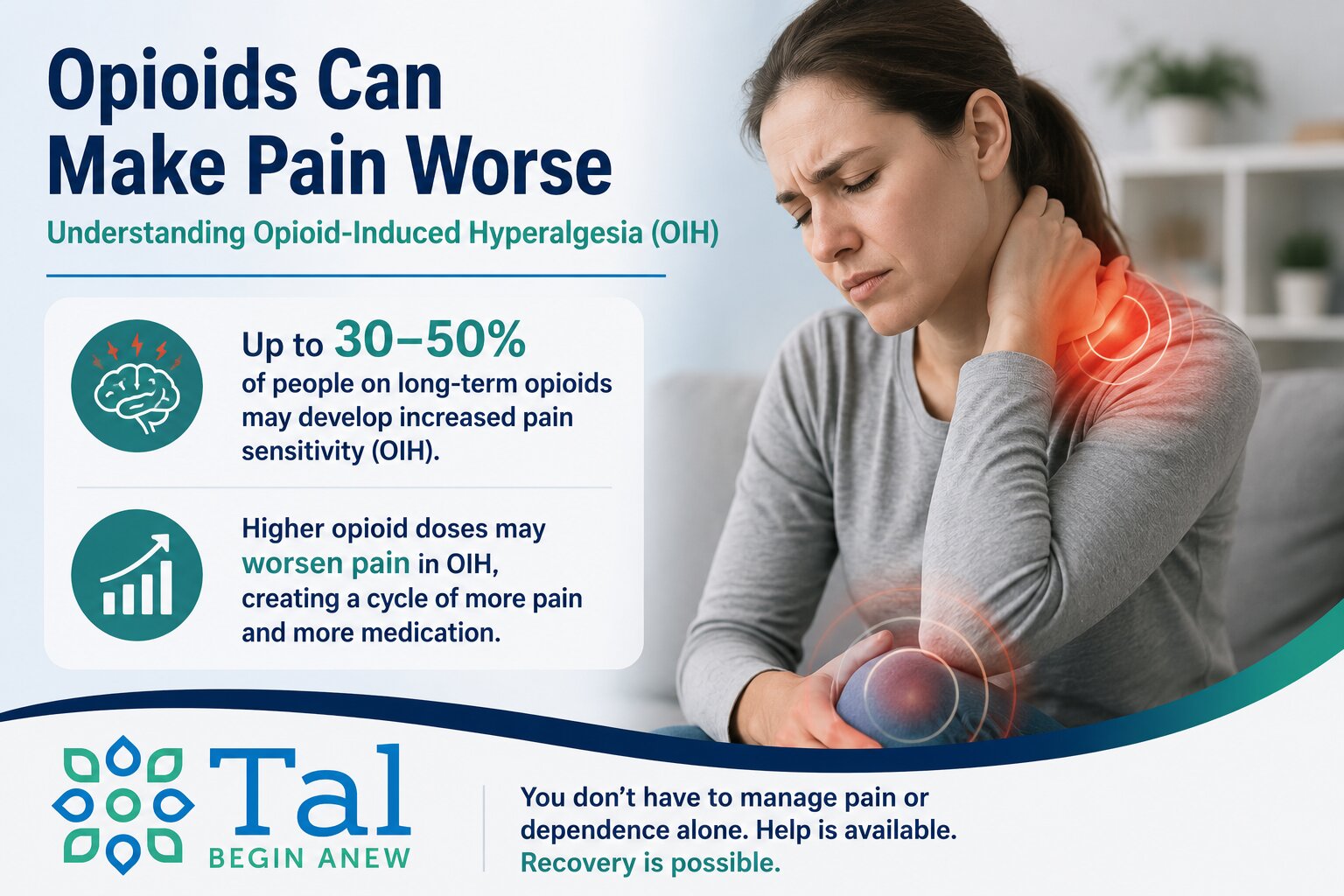
How OIH Drives Dose Escalation and Dependence
One of the most frustrating aspects of OIH is how easily it can create a cycle that feels impossible to escape.
Imagine someone who begins opioid therapy after surgery or a back injury.
Initially, the medication works well.
Months later, pain begins increasing.
The natural assumption is that more medication is needed.
A healthcare provider may increase the dose.
Temporary improvement occurs.
Then the pain returns.
Another increase follows.
Eventually, several things may happen simultaneously:
- Pain continues worsening.
- Higher doses become necessary.
- Physical dependence develops.
- Withdrawal symptoms appear when medication is reduced.
- Daily life begins revolving around managing pain and medication.
From the person’s perspective, increasing medication seems logical because the pain feels very real.
If OIH is contributing to that pain, however, escalating doses may unintentionally reinforce the cycle.
This does not mean every increase in opioid medication is inappropriate.
Many people require carefully managed opioid therapy for serious medical conditions.
The important point is that worsening pain during long-term opioid treatment deserves careful medical evaluation rather than automatically assuming higher doses are the only solution.
Recognizing Possible Signs of OIH
Because OIH shares symptoms with several other conditions, it cannot be diagnosed based on symptoms alone.
However, healthcare providers may consider OIH when someone experiences:
- Pain becoming increasingly widespread
- Increased sensitivity without clear injury progression
- Pain worsening despite increasing opioid doses
- Reduced function despite higher medication use
- Difficulty distinguishing new pain from the original condition
A comprehensive medical evaluation helps determine the underlying cause.
How Treatment Helps
If opioid-induced hyperalgesia is suspected, the goal is not simply to stop opioid medications abruptly.
Stopping opioids suddenly can lead to significant withdrawal symptoms and other medical risks.
Instead, healthcare providers develop individualized treatment plans based on each person’s medical history, pain condition, and overall health.
Treatment may involve several approaches.
Medical evaluation
The first step is determining whether worsening pain is related to:
- The original medical condition
- Opioid tolerance
- OIH
- Another pain disorder
- A combination of factors
Accurate diagnosis guides appropriate treatment.
Medication adjustments
Depending on clinical circumstances, providers may recommend:
- Gradual opioid tapering
- Adjusting opioid medications
- Rotating to a different medication
- Adding non-opioid pain management strategies
These decisions should always be made under medical supervision.
Comprehensive pain management
Effective pain management often includes multiple strategies rather than relying on medication alone.
Treatment plans may incorporate:
- Physical therapy
- Behavioral therapies
- Stress management
- Exercise when appropriate
- Non-opioid medications
- Lifestyle modifications
This multidisciplinary approach can improve both pain control and overall functioning.
Addressing opioid dependence
Some individuals develop physical dependence or opioid use disorder while attempting to manage chronic pain.
In these situations, professional treatment addresses both the physical aspects of opioid dependence and the behavioral patterns that have developed over time.
Recovery involves helping individuals regain control while identifying healthier, evidence-based approaches to managing pain.
Getting Help at Tal Behavioral Health
Living with chronic pain is difficult enough.
Feeling as though the medication meant to help is no longer working—or may even be contributing to worsening pain—can be confusing and discouraging.
Fortunately, help is available.
If long-term opioid use has become increasingly difficult to manage, professional evaluation can determine what factors may be contributing to your symptoms.
At Tal Behavioral Health, care focuses on understanding the whole person rather than only the medication. For individuals struggling with opioid dependence or opioid use disorder, treatment plans address physical recovery, emotional well-being, and long-term strategies that support healthier pain management and sustained recovery.
No one should feel they have to navigate worsening pain or opioid dependence alone.
Seeking professional guidance can provide clarity, safer treatment options, and a path toward lasting recovery. Call Tal Behavioral Health today at 216.930.1957 to speak with a caring team member and learn about your treatment options. The right support can help you recover safely and confidently.
Frequently Asked Questions
Can opioids actually increase pain?
Yes. In some individuals, prolonged opioid use may contribute to opioid-induced hyperalgesia, a condition in which the nervous system becomes more sensitive to pain. This is different from opioid tolerance and should be evaluated by a healthcare provider.
What is the difference between opioid-induced hyperalgesia and tolerance?
Tolerance means the body becomes less responsive to the medication, so higher doses may be needed to achieve the same pain relief. Opioid-induced hyperalgesia involves increased pain sensitivity, where the nervous system amplifies pain signals. Although both can cause worsening pain, they have different underlying mechanisms and require professional evaluation.
What do you do about opioid-induced hyperalgesia?
Do not stop opioid medications on your own. If you believe your pain is worsening despite long-term opioid use, speak with your prescribing healthcare provider. Treatment may involve a comprehensive evaluation, medication adjustments, gradual tapering when appropriate, alternative pain management strategies, or treatment for opioid dependence if needed.
Is opioid-induced hyperalgesia common?
Researchers continue studying how frequently OIH occurs because it can be difficult to distinguish from opioid tolerance or progression of an underlying pain condition. While it does not affect everyone taking opioids, it is a well-documented phenomenon recognized in medical literature.
Can someone recover from opioid dependence if they also have chronic pain?
Yes. Many people successfully recover while continuing to receive appropriate treatment for chronic pain. Recovery often involves individualized care that addresses both pain management and opioid dependence, helping people improve function, reduce risk, and build healthier long-term coping strategies.