I knew how to function. That was my superpower. My calendar was color-coded, my inbox zeroed out, my kids on time, my performance reviews glowing. No one saw the late-night spirals. The morning-after shame. The quiet desperation under every smile.
But the cracks were there—just well-hidden. The day I walked into an Intensive Outpatient Program in Beachwood, I wasn’t falling apart. I was still doing all the things. I just couldn’t carry the lie anymore. And for the first time, someone saw the truth I’d worked so hard to bury.
I Was the One People Came To—Not the One Who Needed Help
The irony? I was everyone’s “strong friend.” The one people called during their own breakdowns. I knew how to hold space, give advice, keep things moving. And I liked that version of me—it made me feel safe, capable, in control.
But control is a funny thing. Mine had turned into a cage. My success covered just enough dysfunction to keep me from calling it what it was. I didn’t drink in the morning. I didn’t miss work. I didn’t “need” help.
But I did.
The Double Life Was Exhausting—and Invisible
On the surface, I was living. Behind closed doors, I was barely holding it together.
I didn’t drink socially anymore—I drank to manage. To come down. To quiet the buzzing anxiety that never really stopped. I told myself I wasn’t like “those people” because my house was clean, my bills were paid, my career on track.
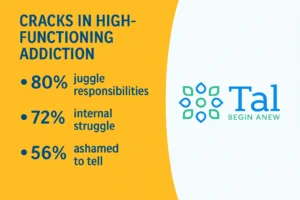
That’s the dangerous thing about high-functioning addiction: it tricks you into thinking you’re fine, just tired. Just stressed. Just going through a phase.
The truth? I was living a double life. And it was killing me slowly.
Shame Keeps You Quiet. IOP Helped Me Speak.
I didn’t tell anyone at first. Not my partner. Not my closest friends. Definitely not my coworkers. I couldn’t bear the idea of someone thinking I wasn’t as together as I seemed.
But pretending was no longer an option.
The night before I called Tal Behavioral Health, I stared at the ceiling for hours, mind racing, body buzzing, thinking: “If I don’t say it soon, I might break in a way I can’t fix.”
Signing up for the Intensive Outpatient Program (IOP) felt terrifying—and necessary. It felt like a confession. Like saying, “I’m not okay” for the first time in my adult life.
And you know what? No one looked at me like I was broken. They looked at me like they got it.
What I Thought Therapy Would Be—And What It Actually Was
I imagined IOP as cold rooms and forced group shares. I expected awkward silences, cheesy metaphors, and people whose problems felt nothing like mine.
Instead, I found a room full of people who also “looked fine.” Professionals. Parents. Quiet strugglers who wore the same mask I did. We didn’t have the same story—but we knew the same silence.
Therapists didn’t rush me to label myself. They let me breathe. Let me unpack the story I’d rehearsed for so long it felt like truth.
There were tears, sure. But there was also laughter. Honesty. Safety. It didn’t feel like punishment—it felt like rest.
Why Intensive Outpatient Fit When Nothing Else Did
I couldn’t drop everything and check into rehab. My life didn’t allow that. I still had responsibilities. People counting on me. That used to be my excuse not to get help—until I realized IOP was designed for people like me.
Three to five days a week. A few hours at a time. Structured enough to feel held, flexible enough to live my life.
It was like scaffolding for my healing. I didn’t have to disappear to get better—I just had to show up and stop pretending.
And that was enough.
Saying “I Have a Problem” Wasn’t Weak—It Was the Start of Freedom
One of the most powerful moments in IOP wasn’t a breakthrough or a dramatic reveal. It was sitting in a chair and saying, “I think alcohol is controlling more of my life than I want it to.”
Simple. Quiet. True.
No one gasped. No one questioned it. They nodded. Someone even said, “Me too.”
There’s something radical about telling the truth in a room where you’re safe to do so. It felt like I was peeling off armor I didn’t even know I’d been wearing. Heavy, suffocating armor I thought I needed to survive.
Underneath it? Me. Tired, yes. Messy, yes. But finally honest.
Recovery Doesn’t Mean Starting Over—It Means Starting Real
Here’s what I thought recovery meant: losing everything and rebuilding from scratch.
Here’s what it actually meant for me: keeping what mattered, losing what didn’t, and finally living without the constant, crushing need to perform.
I didn’t have to quit my job. I didn’t lose my family. I didn’t become a different person.
But I did become a more truthful one.
And that changed everything.
To the Other High-Functioning Strugglers: You’re Not Alone
You don’t have to look “sick enough” to get support. You don’t have to wait for a rock bottom.
IOP didn’t ask me to be anything other than willing. Willing to show up. To be seen. To try.
If you’re functioning but miserable—if you’re polished on the outside and panicked underneath—you’re not broken. You’re just done pretending.
And that’s where healing begins.
Your Strength Isn’t in Holding It Together—It’s in Letting Go
There’s no gold star for managing pain in silence. No trophy for performing wellness while falling apart.
If you’re exhausted by your own performance… step off the stage.
The people at Tal Behavioral Health didn’t applaud my ability to keep it together. They helped me unpack why I thought I had to in the first place.
They helped me find freedom in truth.
And now? I’m still me. Still responsible. Still strong. But I’m not hiding anymore. And I’m not doing it alone.
FAQs About Intensive Outpatient Programs (IOP)
What is an Intensive Outpatient Program (IOP)?
An Intensive Outpatient Program is a structured treatment option that allows individuals to receive therapy and support while maintaining their daily responsibilities—like work, school, or caregiving. It typically includes group therapy, individual counseling, and psychoeducation.
Who is IOP for?
IOP is ideal for people who need more support than weekly therapy but don’t require 24/7 care. This includes individuals struggling with substance use, anxiety, depression, or high-functioning mental health and addiction challenges.
How long does IOP last?
Programs typically run for 8 to 12 weeks, with sessions 3–5 days per week. At Tal Behavioral Health in Beachwood, Ohio, the program is customized to fit your needs and your schedule.
Can I work while attending IOP?
Yes. That’s one of the main benefits of IOP. It’s designed to integrate into your life—not disrupt it. Many people continue working while attending.
Is IOP confidential?
Absolutely. Your privacy is protected, and participation in IOP is not shared with employers or others unless you choose to disclose it.
You Don’t Have to Look Broken to Deserve Help
Call (216) 480-4860 to learn more about our Intensive Outpatient Program services in Beachwood, Ohio.