You don’t have to hit a breaking point to want something better. You might already know you need help. What you might not know is what that help actually looks like—or whether you’re strong enough to handle it.
You’re not alone in that.
At Tal Behavioral Health, we’ve seen hundreds of people come in with the same questions you’re probably asking yourself:
Will this actually help me?
Is this going to be too much?
What if I start and I can’t keep up?
If you’re serious about change—but nervous, unsure, or overwhelmed—this guide to Partial Hospitalization Programs (PHPs) is for you. We’ll walk you through what PHP is, what your days might look like, and how it actually helps.
And if you’re curious about getting started, you can learn more about our PHP program here.
What Is a Partial Hospitalization Program (PHP)?
A Partial Hospitalization Program is an intensive outpatient treatment option designed for people who need more than weekly therapy, but don’t need 24/7 inpatient care. You spend most of the day in structured treatment—and then you go home.
Think of it like this: PHP offers real healing work without completely stepping out of your life. It’s where things get serious, in a safe and supported way.
It’s often used for:
- Anxiety or depression that’s gotten too hard to manage alone
- Trauma recovery that needs more time and care
- Transitional support after hospitalization or crisis
- People who’ve “tried everything” but still feel stuck
A Gentle Start: What the First Few Days Look Like
We don’t expect you to show up on day one and spill your life story. Your first days are about helping you land, not perform.
Here’s what usually happens:
- Initial Assessment: You’ll meet with a clinician who listens—not just takes notes. Together, you’ll explore what’s going on and build a treatment plan that makes sense for you.
- Orientation: You’ll get to know the center, the schedule, and what support looks like here. No one’s thrown in the deep end.
- Soft Entry to Groups: You can observe before fully engaging. You’re encouraged to participate—but never forced.
We respect your pace. And we believe trust can’t be rushed.
What a Typical Day in PHP Actually Looks Like
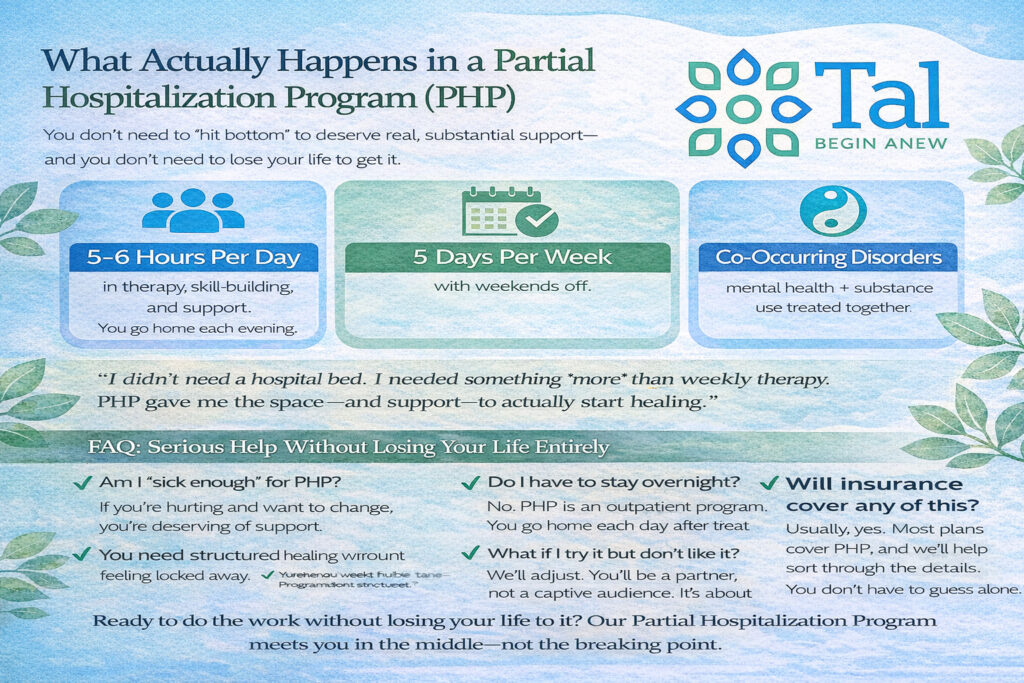
At Tal, PHP is typically 5 days a week, 5–6 hours per day. The structure is there to help you feel grounded. Here’s what a day might include:
- Morning Check-In: A short group session to see how everyone’s feeling and set intentions
- Group Therapy: Topics include anxiety, depression, relationships, boundaries, emotional regulation
- Skills-Based Workshops: Practical sessions—like DBT or CBT-based tools—for real-life challenges
- Individual Therapy (1–2x/week): Dedicated time with your assigned therapist
- Lunch Breaks + Transition Time: You’ll have space to rest and reset between sessions
- Afternoon Wrap-Up or Reflection: Ending the day with clarity, not chaos
It’s immersive but manageable. Structured but never rigid.
What You’ll Really Be Working On
More than symptom management, PHP is about understanding what’s under the symptoms.
Many of our clients are surprised to discover how much they’ve been holding in. Things like:
- “I’ve been performing ‘okay’ for years but feel empty.”
- “I can’t tell the difference between burnout and depression anymore.”
- “I’ve done therapy before—but this feels different.”
That’s because PHP gives you more time, more support, and more space to untangle complex emotions. You’ll build skills to:
- Manage overwhelming thoughts and feelings
- Navigate relationships without losing yourself
- Recognize trauma responses—and respond differently
- Learn to rest, say no, and stay present
Healing Doesn’t Mean Isolation
One of the most healing aspects of PHP? You’re not alone.
You’ll be surrounded by people who are also serious about change. No one’s perfect. No one’s got it all figured out. But everyone’s showing up.
Sometimes, just hearing someone else describe something you’ve been silently carrying for years is enough to spark real change.
What If I’m Not “Sick Enough” for This?
Let’s get something clear: there is no competition for who deserves care.
If you’re functioning, working, or masking—that doesn’t mean you’re not hurting.
If your pain is quiet or your coping looks “productive,” that doesn’t make it less real.
PHP is for people in the middle space. The ones who don’t need a hospital bed—but need more than just one therapy hour a week.
And if you’re already trying to find treatment options in Cleveland or nearby areas like care in Falls, you don’t have to figure it out alone. We can help you decide if PHP is right for you—or what else might be.
What Happens After PHP?
Recovery isn’t linear—and PHP isn’t the end of the road. After completing the program, many clients step down into:
- Intensive Outpatient Program (IOP): Fewer hours per week, continued support
- Weekly Therapy: One-on-one sessions with a therapist for continued care
- Alumni or Aftercare Programs: Community support and continued learning
We help you build a plan that keeps working after you leave our care.
FAQ: Partial Hospitalization Program at Tal Behavioral Health
Is PHP the same as being hospitalized?
No. You go home each day. PHP is outpatient treatment—you don’t sleep at the facility. It’s a structured program during the day, and you return to your home, family, or support network each evening.
Will I lose my job or have to stop everything to attend?
We’ll work with you. Many employers allow leave for mental health treatment (often covered by FMLA). We can help you navigate time-off conversations or explore alternatives like IOP if your schedule is tight.
What if I try it and it doesn’t feel right?
That’s okay. You’re allowed to reassess. Sometimes people step into PHP and realize they need more—or less. We’ll adjust your treatment plan with you. The goal is fit, not force.
How much does PHP cost? Does insurance cover it?
Most major insurance plans do cover PHP services. Our admissions team can help you verify coverage, understand costs, and explore options. We want care to be accessible—not overwhelming.
Can I do PHP if I’m dealing with both mental health and substance use?
Yes. We treat both mental health and co-occurring disorders. If you’re using substances to cope with mental health struggles, you’re not alone—and we’re equipped to help.
You Don’t Have to Be Fearless—Just Willing
If you’re still reading, that tells us something: You want things to be different. Even if you’re scared. Even if you’re unsure. That willingness? That’s more than enough to start.
Whether you’re in Cleveland, seeking help in Shaker Heights, or simply Googling this from your bed at 2 a.m., we see you.
📞 Ready to Take the First Step?
Call (216) 480-4860 or visit to learn more about our Partial Hospitalization Program services in Cleveland, Ohio.