
I remember thinking 90 days would change everything.
Like something would click into place—and stay there.
Not just the big stuff. Even the small things. Sleep. Focus. Relationships.
I thought I’d cross that line and finally feel… steady.
If you’re here, you probably know how that story goes.
Because somewhere after the milestone, things got quiet… and then complicated again.
Not overnight. Not in a dramatic crash. Just a slow drift.
And now you’re back. Or thinking about coming back.
And it doesn’t feel like progress.
It feels like you messed it up.
But that’s not the truth. Not even close.
The Myth: 90 Days Means You’re Done With the Hard Part
People don’t always say this out loud—but it’s everywhere.
Hit 90 days, and you’re supposed to be okay.
Stronger. More stable. Past the worst of it.
So when things start slipping after that, it hits differently.
It’s not just hard—it’s confusing.
You start asking yourself questions like:
- Why am I struggling again?
- Didn’t I already learn this?
- Why can’t I just hold onto it?
Here’s the reality most people don’t talk about:
Ninety days is a beginning—not a finish line.
It gives you space.
It clears some of the noise.
It lets you finally hear yourself again.
And sometimes… what you hear is uncomfortable.
What the “After” Actually Feels Like
There’s a strange gap that happens after those early milestones.
During the first stretch, everything is structured.
There are expectations. Check-ins. Support systems that feel close.
Then slowly, things change.
You’re given more independence.
Less structure. More space.
And that space can feel like freedom at first—until it doesn’t.
Because life starts creeping back in.
Old environments. Old dynamics. Old thoughts that didn’t magically disappear.
You might notice things like:
- You stop sharing honestly because you “should be fine by now”
- You minimize how you’re feeling
- You isolate more, even if you don’t realize it
- You start managing everything internally instead of reaching out
It’s subtle. Quiet. Easy to ignore.
Until one day you realize—you’re not okay again.
The Moment You Realize You Might Need Help Again
It usually doesn’t hit all at once.
It’s a series of small moments:
You wake up feeling heavy for no clear reason.
You lose interest in things that used to help.
You feel disconnected—even from people who care about you.
And then comes the thought you don’t want to admit:
“I might need help again.”
That thought can feel heavier than everything else.
Because now it’s not just about struggling—it’s about what it means.
You start attaching stories to it:
- I should’ve been past this
- People are going to think I didn’t try hard enough
- I’m back at square one
But none of those stories are true.
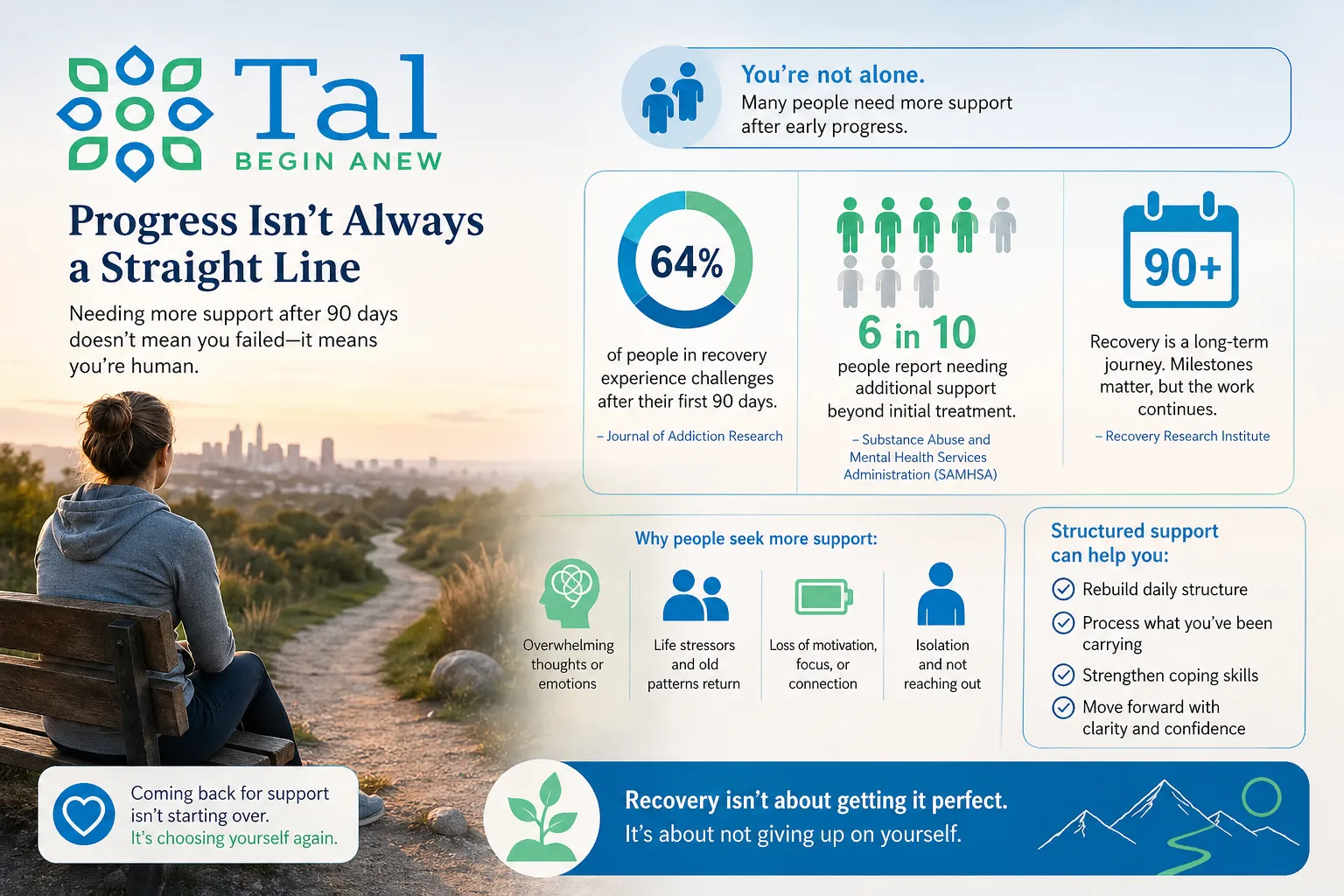
Coming Back Isn’t Starting Over
Walking back into structured care—especially something like mental health day treatment—can feel like defeat.
Like you’re undoing everything you worked for.
But take a second and look at it differently.
You’re not coming back as the same person.
You’re coming back with:
- More awareness of your patterns
- A clearer understanding of what triggers you
- The ability to recognize when something’s off sooner
- The courage to not ignore it this time
That’s not starting over.
That’s continuing—just with more honesty.
Why More Support After 90 Days Actually Makes Sense
There’s this idea that needing structured care again means something went wrong.
But sometimes, it just means the level of support needed changed.
Life after early recovery or stabilization isn’t simple.
In fact, it can feel more intense.
You’re more present.
More aware.
Less numb.
Which means everything hits harder.
That’s where structured daytime care becomes something different.
Not a fallback.
Not a punishment.
But a place to recalibrate.
A place where you don’t have to pretend you’re okay.
Where you can rebuild rhythm again—without pressure.
Where you can look at what actually happened, instead of rushing past it.
The Shame That Keeps People From Coming Back Sooner
This is the part that keeps people stuck longer than they need to be.
Not the symptoms. Not the stress.
The shame.
That quiet voice that says:
“You already had your chance.”
It convinces you to wait.
To push through.
To try to fix it on your own.
And the longer you wait, the heavier everything gets.
Here’s what most people don’t realize:
Coming back sooner isn’t failure—it’s awareness.
It’s recognizing the shift before it becomes something bigger.
It’s choosing to respond instead of react.
You’re Not the Only One Who’s Been Here
It might feel isolating—like everyone else moved forward and you’re the only one who slipped.
But that’s not reality.
A lot of people find themselves needing more support after that initial stretch.
They just don’t talk about it openly.
Some return to structured care.
Some adjust their level of support.
Some rebuild their routine in a different way.
There isn’t one path.
There’s just the next right step.
If you’re in or around Beachwood and quietly trying to figure things out, you’re not alone in looking for help in Cleveland or nearby options that actually meet you where you are right now.
This Isn’t About Getting It “Perfect”
One of the hardest things to let go of is the idea that you were supposed to get it right the first time.
That if you just tried harder, stayed more disciplined, or paid more attention—you wouldn’t be here.
But growth doesn’t work like that.
It’s not clean.
It’s not linear.
It doesn’t follow timelines.
Sometimes it loops back.
Sometimes it deepens.
Sometimes it asks you to revisit things you thought you already understood—just from a different angle.
That’s not regression.
That’s real work.
A Different Way to Look at This Moment
Instead of asking:
“Why am I back here?”
Try asking:
“What is this moment trying to show me?”
Not in a philosophical way. In a real, grounded way.
Maybe it’s showing you that:
- You need more consistent support than you thought
- Your environment is affecting you more than you realized
- You’ve been carrying things you never fully processed
- You’ve outgrown the level of care you had before
That kind of awareness doesn’t come from failure.
It comes from experience.
FAQs: What People Quietly Wonder at This Stage
Is it normal to need more help after 90 days?
Yes. More common than people admit. Early progress creates space—but deeper layers often show up later. That doesn’t mean you’re going backward.
Does going back into structured care mean I failed?
No. It means you recognized something wasn’t working and chose to address it. That’s a strong, self-aware decision—not a failure.
Why do things feel harder after some progress?
Because you’re more present. Less numb. More aware of your thoughts, emotions, and patterns. That awareness can feel heavier at first.
How do I know if I need more structured support again?
If you’re feeling overwhelmed, disconnected, or like you’re managing everything alone again—it might be time to explore more support. You don’t have to wait for things to get worse.
What if I feel embarrassed to come back?
That feeling is normal—but it shouldn’t stop you. Most people providing care understand this cycle deeply. You’re not being judged—you’re being supported.
Can structured daytime care actually help the second time?
Yes—often even more. You come in with more insight, which can make the work deeper and more effective.
What if I’m not “as bad” as before?
You don’t have to reach a breaking point to deserve help. Getting support earlier can prevent things from escalating.
You’re Not Back at the Beginning
It might feel like it.
But you’re not the same person you were before.
You’ve already done hard things.
You’ve already built awareness.
You’ve already experienced what stability can feel like.
Even if it slipped—you know it exists.
And that matters.
More than you think.
If something in you is quietly saying, “I need support again,” that voice is worth listening to.
Call 216-480-4860 or explore our Partial Hospitalization Program in Beachwood, Ohio to learn more.
You don’t have to prove anything.
You just have to keep going.