
You did the brave thing. You reached out. You said it out loud: I need help.
Maybe you whispered it into a phone. Maybe you typed it into a contact form and hesitated before hitting “send.” However you got here, you’re here now.
And that matters.
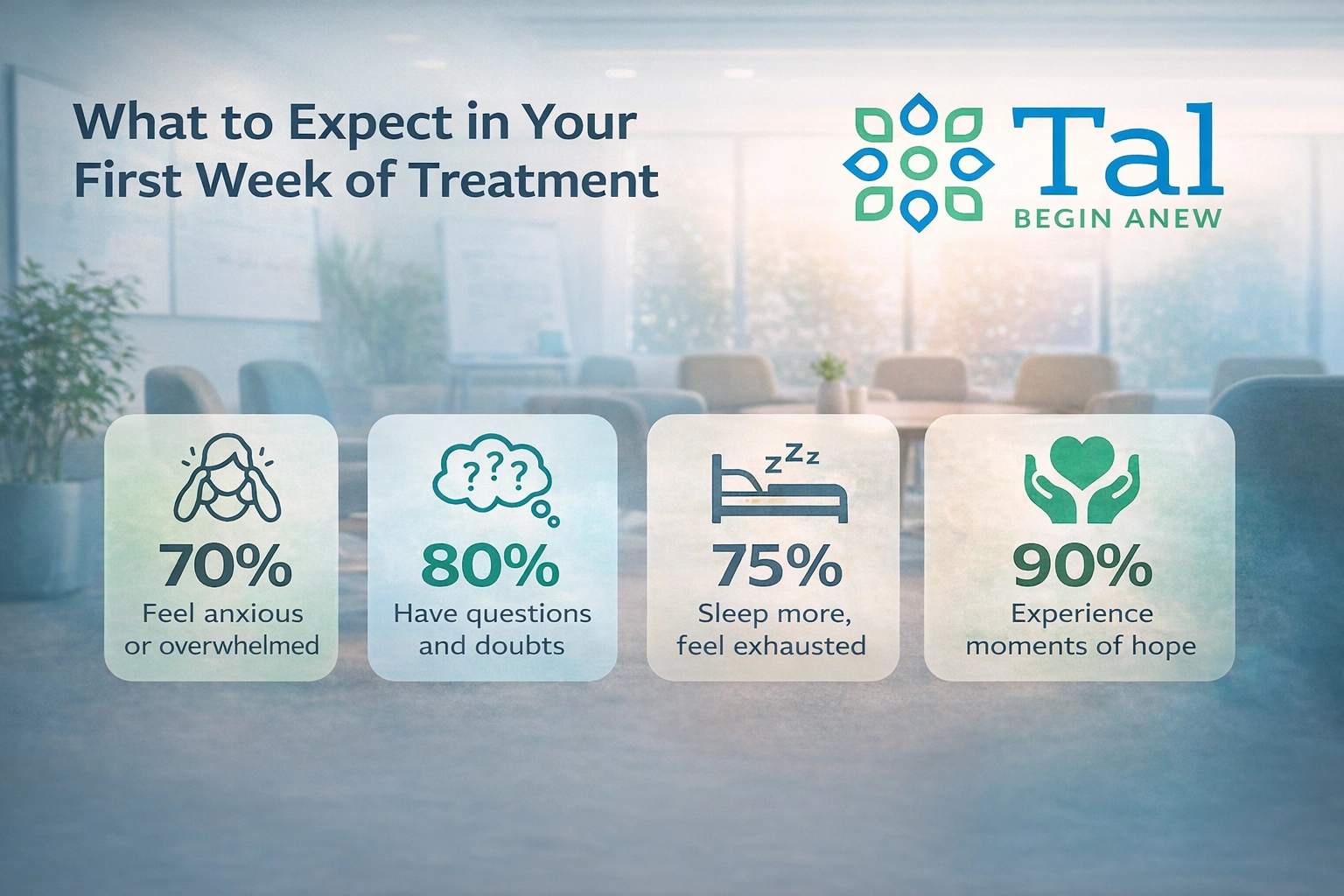
If you’re about to begin a structured treatment program, you might be feeling more than one thing: anxiety, relief, doubt, hope. That’s normal. Your mind might be racing with questions: What will it be like? Will I fit in? Will this actually help?
At Tal Behavioral Health, we know the first week of treatment isn’t just about clinical schedules. It’s about the emotional terrain—what it feels like to walk through those doors for the first time. This blog is here to help you anticipate, normalize, and even honor that.
This isn’t about pressure. It’s about permission—permission to feel however you feel, and to start where you are.
And if you’re not sure where to start, our structured daytime care can meet you exactly there.
You May Feel Everything—and Nothing
There’s no right emotional reaction to starting treatment. Some people cry in the parking lot. Some people feel numb. Some people overtalk in nervousness. Others shut down completely.
You might think, Why am I not more relieved? or Why don’t I feel anything at all?
That’s okay.
Starting treatment is like walking into a storm you’ve been avoiding for a long time. Just showing up takes energy. Sometimes there’s nothing left in the tank to feel much else.
Let that be okay. Numbness is often your body’s way of keeping you safe in new environments. Emotions come later—and they’ll come more freely when you stop expecting them to behave a certain way.
Intake Day: It’s a Conversation, Not a Cross-Examination
On day one, you’ll go through an intake process. And if you’re already feeling guarded, that can sound like a threat. But it’s not.
At Tal, intake is a conversation. A gentle, structured way to learn your story and your needs. You won’t be expected to spill everything. You won’t be met with shock or judgment. You’ll talk about your history, your symptoms, your goals—at your pace.
The goal isn’t to diagnose you and move on. It’s to build a plan around you.
And if you’re local, this is also where we might talk about options for support in Cleveland or help in Falls that fit logistically and emotionally with your life.
The Structure Might Feel Weird—And Healing
Your week will have rhythm. You’ll have a schedule. You’ll meet in groups. You’ll talk one-on-one with a therapist. You’ll get breaks. You’ll check in. You’ll learn names. You’ll hear stories that feel like pieces of your own.
For some people, having a plan feels immediately comforting. For others, it can feel rigid or overwhelming at first—especially if you’ve been living in chaos, avoidance, or survival mode.
But structure isn’t punishment. It’s a way to reduce emotional decision fatigue.
When your life has been unpredictable, predictable care can feel like a lifeline.
Let it carry you—even if you don’t fully trust it yet.
Group Therapy: The Place Where Shame Starts to Shrink
The idea of group work can feel terrifying at first. You might think, I’m not ready to share. These people don’t know me. What if I say the wrong thing?
But here’s what often happens:
You sit in a group. Someone else speaks first. Their story doesn’t match yours exactly, but something in it echoes in your chest. And for the first time in a long time, you think, Maybe I’m not the only one.
That moment? That’s where shame starts to loosen its grip.
You don’t have to tell your whole story right away. You don’t even have to talk. Just being in the room is enough.
You Might Want to Leave—That’s Not Failure
Almost everyone has a moment during week one where they think, I don’t belong here.
Or: This was a mistake.
Or even: I feel worse now than I did before I started.
This is your brain reacting to unfamiliar vulnerability. You’ve opened the door to change, and that can feel scary—even when it’s good.
It doesn’t mean treatment isn’t working. It means you’re in it.
Don’t keep that feeling to yourself. Say it out loud to your therapist, your group, or the clinical team. There’s nothing you can bring up that we haven’t heard before. And chances are, we’ll help you carry it instead of judging it.
You’ll Probably Sleep Differently—and Think Differently
Your body keeps score. And sometimes when you finally land somewhere safe, it takes that moment to crash.
That’s why many people sleep more than usual in their first week. Or find themselves thinking thoughts they haven’t had space to think before. Or feeling feelings they’ve numbed out for years.
Again—this isn’t failure. It’s your nervous system starting to come down from years of high-alert survival.
Be gentle with yourself here. Let the tiredness come. Let the thoughts swirl. You’re not regressing. You’re releasing.
You Won’t Know What You’re “Supposed” to Do—That’s the Point
There’s no rulebook for healing. No badge for getting it “right.”
You might feel like everyone else is catching on faster than you. You might not know what your goals are yet. You might not feel clear at all.
That’s okay. Your first week isn’t about having the answers. It’s about showing up enough to ask better questions.
You can be unsure and still be making progress. You can be scared and still be brave. You can be overwhelmed and still belong here.
Tiny Moments Will Surprise You
In between the sessions, the learning, the heavy lifting—you’ll probably experience a few small, unexpected moments of peace.
Maybe it’s a laugh during a break. Maybe it’s hearing someone say something that makes you feel understood. Maybe it’s just sitting still without panic for the first time in weeks.
These moments aren’t distractions. They’re clues. They show you what’s still possible.
Hold onto them. Let them grow.
FAQs: First-Week Feelings and Practicalities
Will I have to talk in every group?
No. You’re encouraged to participate when you’re ready, but silence is okay too. Listening is a form of healing. No one will force you to speak.
What if I feel like I don’t belong?
You’re not alone in that feeling—and ironically, that’s exactly what connects most people. Everyone feels out of place at first. Let that be part of the process.
Do people cry during the first week?
Yes. A lot of people do. And no one thinks less of you for it. It’s often the first safe place people have had to release long-held emotions.
What if I feel worse before I feel better?
That’s normal. Sometimes slowing down reveals feelings you’ve been pushing down. The team will support you through it, and things will get lighter.
Will I have access to support if I’m struggling at home during that first week?
Yes. Structured programs often include access to crisis support or extra check-ins during off-hours. Don’t be afraid to ask for more support.
You Don’t Have to Know Everything to Begin
You’re not expected to show up healed. You’re not expected to be “ready” in a way that looks perfect. You’re allowed to be unsure, guarded, even scared.
You’re also allowed to be hopeful.
That first week is hard—but it’s also sacred. It’s where the momentum begins. Where you stop managing everything alone. Where you let someone else carry part of the weight.
Let this be your beginning.
Call 216-480-4860 to learn more about Partial Hospitalization Program in Cleveland, Ohio. You don’t have to know where you’re going to start the journey. You just have to take the first real step. We’ll walk with you from there.