
You’re not falling apart.
That’s what makes this harder to admit.
You’re still working, still answering texts, still showing up for the people who count on you. From the outside, your life probably looks stable—maybe even successful.
But something shifted.
And if you’ve quietly searched for something like evening outpatient rehab near me, that shift has already started to become real.
You’re Still Performing—But It Feels Different Now
There was a time when your routine felt manageable.
Now it feels managed.
That’s a subtle but important difference.
You’re not moving through your day—you’re holding it together. You’re calculating how much energy you have, how to pace yourself, when you can finally shut off.
Even the things you used to enjoy feel like something you have to get through.
That’s usually the first crack.
Not a breakdown. Just a quiet awareness that something isn’t lining up anymore.
The Exhaustion You Can’t Explain to Anyone
This isn’t just about being tired.
It’s the kind of exhaustion that doesn’t go away with a weekend off or a good night’s sleep.
It’s mental. Emotional. Constant.
You might notice:
- You feel “on” all the time, even when you’re alone
- Your mind doesn’t slow down unless you force it to
- You rely on something—alcohol, substances, habits—to transition out of your day
- You feel disconnected from moments that should feel meaningful
From the outside, none of this is obvious.
Inside, it’s loud.
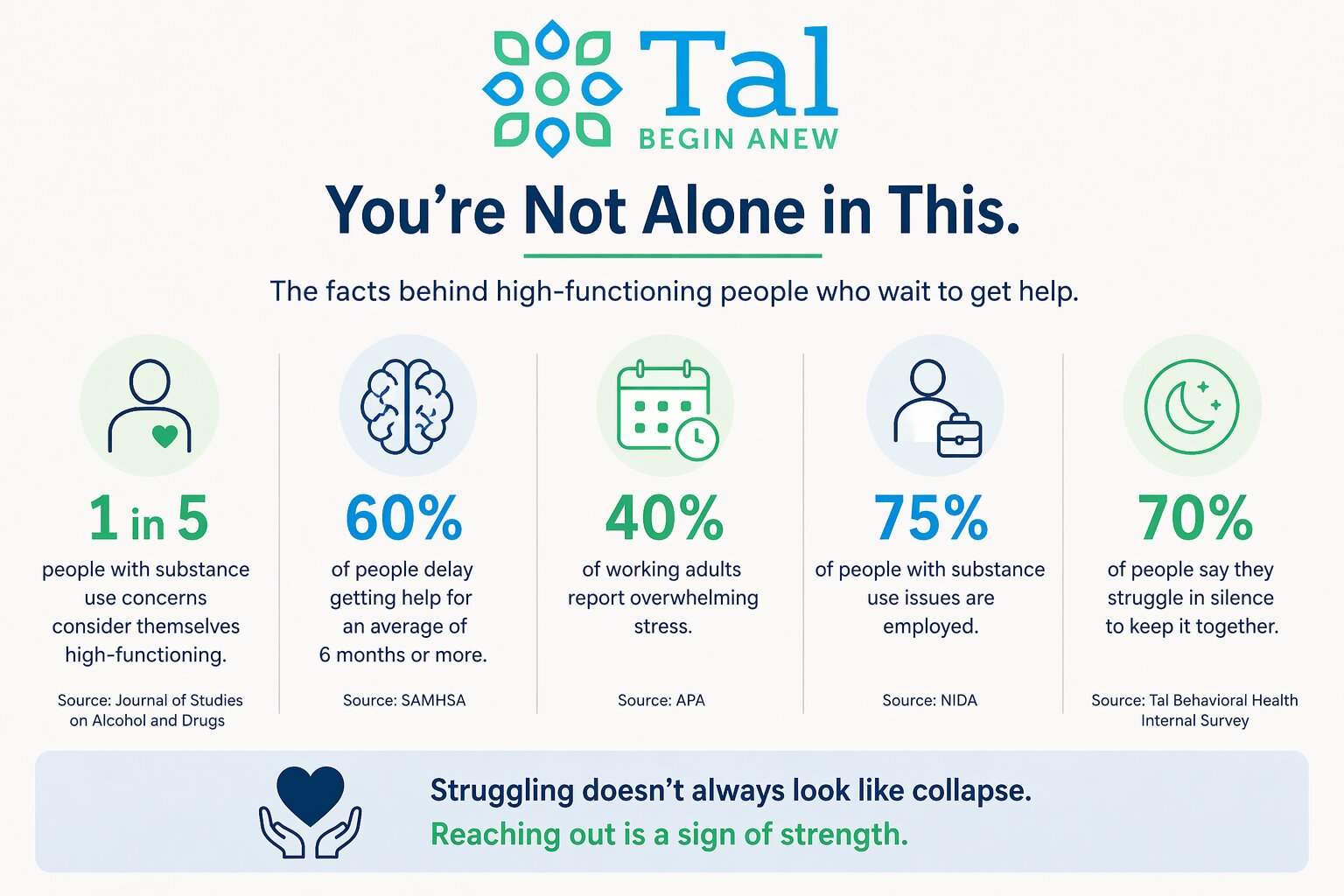
Why High-Functioning People Wait Longer Than They Should
Because nothing is forcing you to stop.
You’re capable. Reliable. Productive.
That becomes the reason you delay getting help.
You tell yourself:
- “I still have control.”
- “I haven’t crossed a line.”
- “This is just stress.”
But here’s what we see every day:
High-functioning people don’t avoid consequences. They absorb them longer.
And by the time they reach out, they’re not just tired—they’re depleted.
The Identity Trap: “This Isn’t Me”
One of the hardest parts of this stage is identity.
You don’t see yourself as someone who needs treatment.
You’re not the stereotype. You haven’t lost your job. You’re not in crisis.
So your brain keeps trying to file this under something temporary.
Stress. Burnout. A phase.
But the longer it continues, the harder it becomes to ignore the truth:
You can be high-functioning and still need support.
Those two things are not opposites.
The Moment It Gets Hard to Ignore
There’s usually a turning point.
Not dramatic. Not public.
Just a moment where the usual explanations stop working.
Maybe it’s:
- Realizing you’re thinking about your next drink earlier in the day
- Noticing your patience is gone in situations that used to be easy
- Feeling a sense of dread about repeating the same cycle again tomorrow
- Catching yourself wondering how long you can keep this up
That’s the moment this stops being theoretical.
That’s the moment people start looking for options they hadn’t considered before.
Why Walking Away From Your Life Doesn’t Feel Like an Option
For many high-functioning people, the idea of full-time or live-in treatment feels like too much.
You’ve built a life. People depend on you. You can’t just step away.
So you stay stuck between two choices that don’t feel right:
- Keep going the way you are
- Or blow up your entire routine
Neither feels realistic.
That’s why so many people stay in this space longer than they should.
There’s a Middle Ground Most People Don’t Know Exists
You don’t have to disappear from your life to get real support.
There are structured options designed for people exactly in your position—people who need consistency, accountability, and depth without stepping away from work or family.
This kind of support fits into your life:
- After work hours
- Multiple days a week
- Built around real conversations, not surface-level check-ins
It’s not about pausing your life.
It’s about changing how you move through it.
What Actually Changes When You Stop Managing Alone
Something shifts when you stop carrying this by yourself.
Not overnight. Not perfectly.
But noticeably.
You start to:
- Feel less reactive and more aware
- Understand your patterns instead of just repeating them
- Have space to be honest without performing
- Build structure that doesn’t rely on willpower alone
And maybe most importantly—you stop feeling like you’re the only one dealing with this.
Because you’re not.
You’re Not the Only One Who Looks “Fine”
This is the part most people don’t realize until they’re in a room with others who get it.
The people sitting next to you don’t look like what you expected either.
They have careers. Families. Responsibilities.
They’ve been holding it together too.
That moment—when you realize you’re not alone in this version of the struggle—is often where the pressure starts to ease.
If you’re in the area, some people begin by exploring help in Cleveland or looking into more localized support like help in Shaker Heights. Proximity matters. The easier it is to access, the more likely you are to follow through.
The Real Risk Isn’t Failure—It’s Staying Here
You’re not on the edge of losing everything.
That’s not the risk.
The real risk is staying in a pattern that slowly drains you while everything still looks fine on the surface.
Because you can keep going like this.
That’s what makes it dangerous.
But there’s another option.
Not extreme. Not disruptive.
Just different.
And sometimes, different is enough to change everything.
Frequently Asked Questions
Do I have to stop working to get this kind of support?
No. Many people in this stage specifically choose options that fit around their work schedule. Support can happen in the evenings or at times that don’t interfere with your responsibilities.
What if I’m not “bad enough” for treatment?
This is one of the most common thoughts—and one of the biggest barriers. You don’t need to hit a certain level of severity to deserve help. If it’s affecting you, it matters.
Will people find out I’m getting help?
No. Treatment is confidential. You can choose who you tell and how much you share. Many people go through this process privately.
What actually happens during this kind of program?
You’ll have structured sessions throughout the week that focus on understanding patterns, building coping strategies, and creating sustainable change. It’s practical, not performative.
What if I’ve tried to cut back on my own and it didn’t work?
That’s more common than you think. Change is harder when you’re doing it alone. Structured support adds accountability, perspective, and tools that are hard to build by yourself.
How do I know if it’s time to take the next step?
If you’re asking that question, you’re already closer than you think. Most people don’t explore options until something inside them knows this isn’t sustainable.
If this felt uncomfortably familiar, that’s worth paying attention to.
You don’t have to keep carrying this quietly.
Call 216-480-4860 or visit our intensive outpatient program services in Beachwood, Ohio to learn more about our intensive outpatient program services in Beachwood, Ohio.