
Nobody at work knows how bad it’s gotten.
That’s the strange part.
You’re still answering emails. Still making deadlines. Still showing up to meetings with coffee in hand, acting normal enough that nobody asks questions. From the outside, your life probably looks stable. Successful, even.
But privately, things feel different.
Maybe your first thought every morning is about getting through the day so you can finally drink. Maybe you’re relying on substances just to slow your brain down enough to sleep. Maybe your weekends revolve around recovering from the week — physically, emotionally, chemically.
A lot of high-functioning people spend years convincing themselves they don’t “need treatment” because they’re still productive. They compare themselves to stereotypes and decide they’re not bad enough yet.
Meanwhile, they’re exhausted in ways they can’t explain to anyone.
If you’ve been searching for a way to get help without losing your career, disappearing from your responsibilities, or blowing up your entire life, there are treatment options built for exactly that reality. Many professionals begin with flexible multi-day weekly treatment because it allows them to keep working while finally addressing what’s happening underneath the surface.
High-Functioning Doesn’t Mean Healthy
A lot of people use work performance as proof they’re okay.
“I’m still paying bills.”
“I’m still succeeding.”
“I’m still handling things.”
But functioning and suffering can exist at the same time.
In fact, many high-achieving people become better at hiding addiction because they’re so used to pushing through discomfort. They’ve trained themselves to override exhaustion, anxiety, loneliness, burnout — all of it.
That ability may have helped you survive professionally.
It may also be part of what’s keeping you stuck.
One of the most painful realities of high-functioning addiction is that people often don’t get help until they’re emotionally collapsing in private. Not because they don’t care. Because their external success keeps convincing everyone — including themselves — that things aren’t serious yet.
But addiction is not measured only by visible destruction.
Sometimes it’s measured by how small your inner world has become.
The Mental Load Gets Heavier Than the Substance Itself
At some point, addiction stops being about enjoyment.
It becomes management.
Managing your stress.
Managing your mood.
Managing withdrawals.
Managing appearances.
Managing the fear that people are starting to notice.
People with high-functioning addiction often describe feeling like they’re living two separate lives at once.
There’s the professional version everyone sees.
Then there’s the exhausted version trying to calculate:
- How much alcohol is left at home
- Whether you can safely drive tomorrow morning
- How to hide how rough you feel
- Whether tonight is the night you finally cut back
- Why your anxiety feels unbearable without substances
That internal split drains people over time.
One client once said:
“I wasn’t even drinking to feel good anymore. I was drinking to feel baseline human.”
That’s the kind of sentence people usually whisper after years of pretending they’re fine.
The Fear of Losing Everything Keeps People Stuck Longer
A lot of professionals know they need help long before they reach out.
The problem is fear.
They’re terrified treatment will cost them:
- Their career
- Their reputation
- Their routine
- Their financial stability
- Their identity
Especially for people who’ve spent their lives being dependable, asking for help can feel like personal failure.
But many forms of modern addiction treatment are specifically designed for people who need flexibility.
That’s why more people are exploring outpatient addiction treatment Cleveland programs that allow them to continue working while receiving support.
For some people, treatment involves evening sessions after work. Others benefit from structured daytime care that still allows them to stay connected to family and responsibilities.
The point is not to rip your life apart.
The point is to help you stop surviving it alone.
You Don’t Need a Public Collapse to Deserve Help
This part matters more than most people realize.
You do not need:
- A DUI
- A lost job
- A divorce
- An overdose
- A dramatic intervention
- Public humiliation
to justify getting support.
A lot of people wait for a catastrophic moment because they think it will finally “prove” they need help.
But honestly, many high-functioning people never experience one giant collapse.
Instead, they slowly disappear from themselves.
They become emotionally flat. Irritable. Disconnected. Restless. Lonely.
Their relationships become thinner. Their stress tolerance drops. Sleep gets worse. Joy becomes harder to access without substances.
Life starts feeling like something to survive instead of something to live.
And because they’re still functioning outwardly, nobody sees how much pain they’re carrying internally.
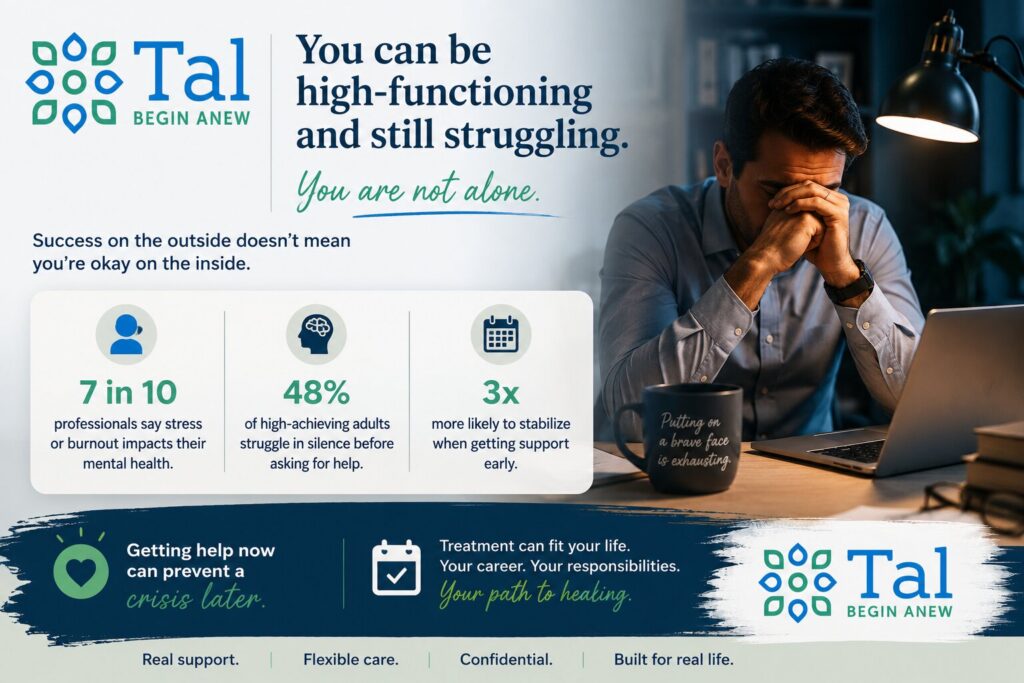
Addiction in High Achievers Often Looks Like Burnout First
Many people seeking help don’t initially think addiction is the issue.
They think they’re just:
- Burned out
- Overworked
- Stressed
- Mentally exhausted
- Struggling with anxiety
And sometimes all of that is true.
But substances often become the coping system holding everything together temporarily.
Alcohol becomes the off-switch.
Cocaine becomes the productivity tool.
Pills become the emotional buffer.
Weed becomes the escape hatch.
Over time, the nervous system starts depending on those patterns to regulate itself.
That dependency can happen quietly.
Especially in environments where overworking and stress are normalized.
One of the hardest things for high-functioning people to admit is that they may have built an entire adult life around managing emotional exhaustion instead of actually healing it.
The Version of You People Praise May Be Deeply Tired
A lot of successful people secretly feel trapped by the image they’ve built.
Everyone sees them as capable. Reliable. Strong.
So they keep performing strength even when they’re falling apart internally.
That isolation can become brutal.
There’s a specific loneliness that comes from being surrounded by people who admire your productivity while nobody understands how hard you’re struggling to maintain it.
You can be deeply loved and still feel emotionally unseen.
You can be successful and still feel completely disconnected from yourself.
You can be the person everyone depends on while quietly wondering how much longer you can keep carrying this.
And eventually, many people reach a breaking point that isn’t dramatic from the outside — just deeply painful internally.
Usually it sounds something like:
“I can’t keep living like this.”
Getting Help Doesn’t Mean You Failed at Life
This is where shame keeps people trapped.
Many professionals view treatment as evidence they weren’t disciplined enough, strong enough, or successful enough to manage things on their own.
But addiction recovery is not about weakness.
It’s often about finally stopping the performance.
Good treatment is not designed to punish you. It’s designed to help you understand what’s actually driving the exhaustion, pressure, anxiety, loneliness, or emotional pain underneath the substance use.
For many people, treatment becomes the first place they’ve been honest in years.
Not polished.
Not impressive.
Just honest.
And surprisingly, that honesty often feels like relief.
Because pretending everything is fine is exhausting.
Recovery Usually Begins Smaller Than People Expect
Most people imagine recovery beginning with some giant life-changing moment.
In reality, it often starts quietly.
One honest conversation.
One phone call.
One assessment.
One sentence you finally stop swallowing:
“I think I need help.”
That’s enough.
You do not need to know exactly what comes next before reaching out.
Many people begin by exploring flexible treatment options in Cleveland or nearby help in Shaker Heights that fit around work and daily responsibilities.
And despite what fear tells you, getting support does not mean your life is over.
For many people, it’s the first time their life starts feeling manageable again.
FAQ: Addiction Treatment for Working Professionals
Can I keep working while getting addiction treatment?
Yes. Many outpatient programs are designed specifically for working adults who need support while maintaining employment and responsibilities.
What if my addiction doesn’t seem “serious enough”?
You do not need to lose everything before getting help. If substances are affecting your emotional health, stress levels, sleep, relationships, or daily functioning, support may still be appropriate.
Will treatment interfere with my career?
Many people continue working while attending outpatient care. Flexible scheduling options can help treatment fit around professional responsibilities.
What does outpatient treatment usually involve?
Treatment often includes therapy, group support, coping skill development, relapse prevention, and emotional support several days a week while allowing people to continue living at home.
What if I’m ashamed to ask for help?
That feeling is incredibly common, especially among high-functioning people. Shame often convinces people they should be able to “handle it alone.” But support exists precisely because many people cannot carry this by themselves forever.
Do I have to identify as an addict to start treatment?
No. Many people begin treatment because they recognize substances are affecting their life, stress, emotions, or relationships — even if they are unsure about labels.
What if I’ve tried to quit before and couldn’t?
That does not mean recovery is impossible. Many people attempt to cut back or stop multiple times before finding sustainable support and structure.
Is outpatient care confidential?
Yes. Treatment providers prioritize privacy and confidentiality. Many professionals receive care while continuing their normal routines.
Call (216) 480-4860 or visit our multi-day weekly treatment programs to learn more about our programs and iop services in Cleveland.