
When relapse happens, it doesn’t just affect the person using. It ripples through the entire family—especially the parents.
You may have felt relief when your child first completed treatment. Maybe you thought, “We finally made it.” And now—here you are again. Confused. Exhausted. Heartbroken. Wondering what else there is to try.
If you’re looking for something structured yet less overwhelming than inpatient care, a Partial Hospitalization Program in Beachwood, Ohio might be the compassionate middle ground you didn’t know existed.
Relapse Is Not a Moral Failure—For You or Your Child
First, let’s say this out loud: relapse is common. Painful? Yes. Frustrating? Always. But it’s not proof that your child doesn’t care or that you didn’t do enough.
Relapse is part of many people’s path to lasting recovery. Not a sign that they’re doomed—just that they need more support, or maybe a different kind this time.
As a parent, it’s easy to spiral into self-blame. Did I miss the signs? Did I do too much? Not enough? But healing isn’t linear. It never has been.
What matters most now is what happens next.
Understanding the Partial Hospitalization Program (PHP) Model
A Partial Hospitalization Program (PHP) is one of the most structured levels of outpatient care. It’s designed for people who need intensive support during the day—but who don’t need 24/7 residential treatment.
Here’s what that usually looks like:
- Daily clinical programming (usually 5–6 hours a day, 5 days a week)
- Individual therapy and group therapy
- Skill-building workshops focused on emotional regulation, relapse prevention, and life planning
- Psychiatric care, including medication management if appropriate
- Family support, when needed and wanted
At night, your child comes home—or to a sober living environment—where they can begin to practice what they’re learning in real life.
For many young adults, that rhythm of treatment by day and home life by night is both grounding and empowering. It allows for deep work without full disconnection from family or community.
Why PHP Can Work Well After a Relapse
Relapse can feel destabilizing. Your child might be overwhelmed, ashamed, or unsure how to re-engage. A PHP offers them structure without isolation—a place to feel seen, supported, and not judged.
Here’s why parents often choose PHP after relapse:
- It offers stability quickly — No waiting weeks for residential openings
- It rebuilds therapeutic trust — Especially if your child is reluctant to return to treatment
- It bridges the gap — Between early recovery and independent life
- It lowers re-entry resistance — Since it doesn’t require leaving home for weeks or months
PHP is a place for your child to re-learn what recovery looks like—on their terms, in real time.
A Parent’s Story: “I Thought We Were Past This”
“My son was doing well for months after treatment. Then he stopped going to meetings, started hanging out with old friends… you can guess the rest. I blamed myself. But when we found Tal’s PHP, it felt like someone finally met us where we were. He didn’t need a full restart—he needed a real reset. That’s what this gave us.”
– Parent of a PHP Client, 2023
You’re not alone in this moment. Many parents have stood where you’re standing—afraid, angry, unsure what comes next. And many have found healing in the in-between space that PHP provides.
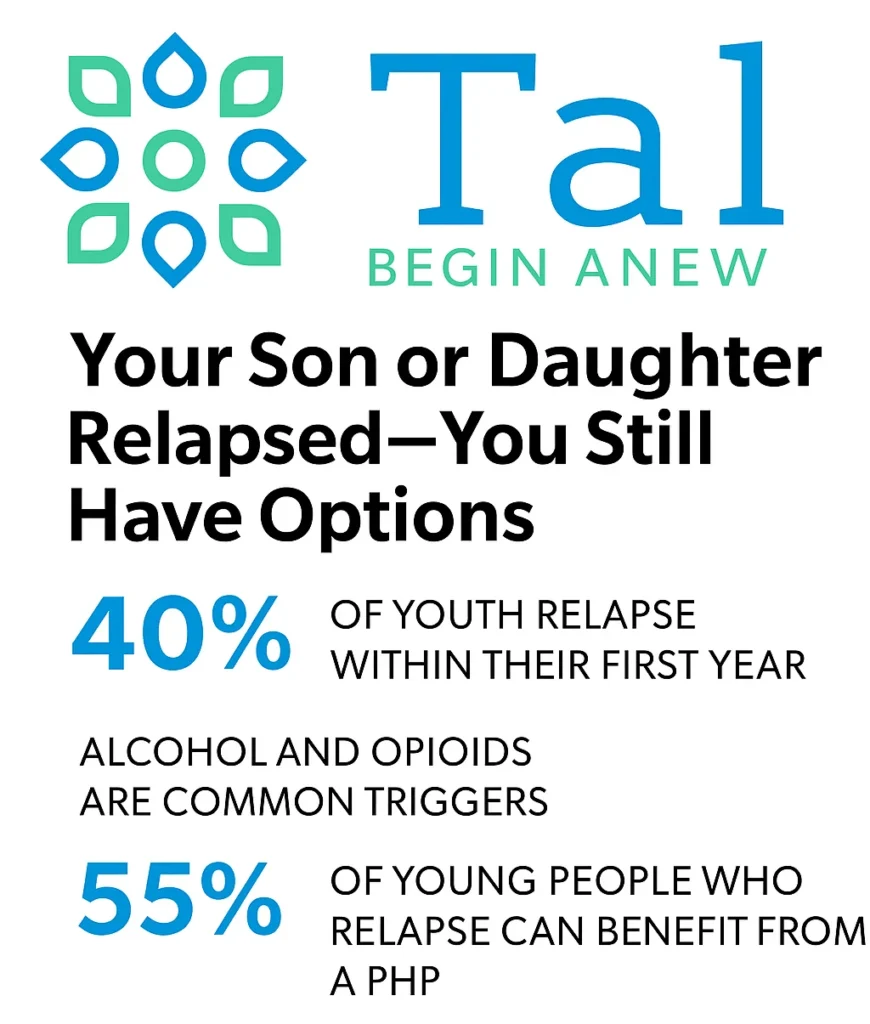
What to Expect at Tal Behavioral Health’s PHP
At Tal Behavioral Health in Beachwood, Ohio, our Partial Hospitalization Program is rooted in structure, compassion, and realism. We understand that relapse recovery isn’t about punishment—it’s about recommitment.
Here’s what your family can expect:
- A safe, non-judgmental environment for young adults to process relapse without shame
- Therapists trained in relapse-sensitive care who know how to meet clients where they are emotionally
- A weekly schedule that includes group therapy, individual therapy, skills classes, and psychiatric check-ins
- Care coordination to support school, work, or home transitions
- Family sessions, when helpful, to support boundary-setting and repair
We’re not here to scold. We’re here to support your child back into the rhythm of recovery—and help you find solid ground too.
How Do I Know If My Child Is Ready for PHP?
You don’t have to know everything right now. But here are some indicators that PHP might be a good next step:
- They’ve relapsed but are open—or at least not resistant—to re-engaging
- They don’t meet the threshold for inpatient care but need more than weekly therapy
- They benefit from routine, structure, and peer connection
- Your home environment can support evening and weekend recovery
- You want a plan that supports both your child and your role as a parent
Still unsure? You can call us. We’ll talk you through it—gently, and without pressure.
You Deserve Support, Too
It’s easy to lose yourself in your child’s struggle. But your well-being matters just as much.
Whether you’re still holding hope, running on empty, or somewhere in between—know this: you’re not alone, and this isn’t the end.
There are programs like PHP that don’t just help your child—they help you feel supported again too.
FAQ: Partial Hospitalization Program After Relapse
What’s the difference between PHP and inpatient rehab?
PHP is daytime-only treatment. Your child sleeps at home or in a sober living space.
Inpatient rehab requires 24/7 residence. It’s typically used for detox or when full-time supervision is needed.
PHP is ideal when someone is medically stable but needs intensive, daily support.
How long does a PHP program usually last?
Most PHP programs last between 2–6 weeks, depending on the individual’s progress and needs. At Tal Behavioral Health, we work collaboratively to assess readiness for stepping down to IOP or outpatient therapy.
Can my child go to school or work while in PHP?
It depends on the schedule and intensity of care needed. PHP is typically a full-day commitment, so working or attending classes might not be possible during the program. That said, our team helps coordinate next steps so your child can transition smoothly back to school or work afterward.
Is PHP covered by insurance?
Often, yes. Many insurance plans cover PHP as part of their behavioral health benefits. We can verify your coverage and walk you through what’s included and what’s not—so there are no surprises.
What if my child doesn’t want to go?
Resistance is common, especially after relapse. We offer gentle, no-pressure conversations that can help your child feel safe enough to consider care again. Sometimes it’s about finding the right program, not just any program.
📞 Let’s Take the Next Step Together
If you’re ready to explore the Partial Hospitalization Program at Tal Behavioral Health—or just want to talk with someone who understands—call (216) 480-4860 or visit Cuyahoga, Summit, Stark. We’re here to help you find the path forward, one honest step at a time.