
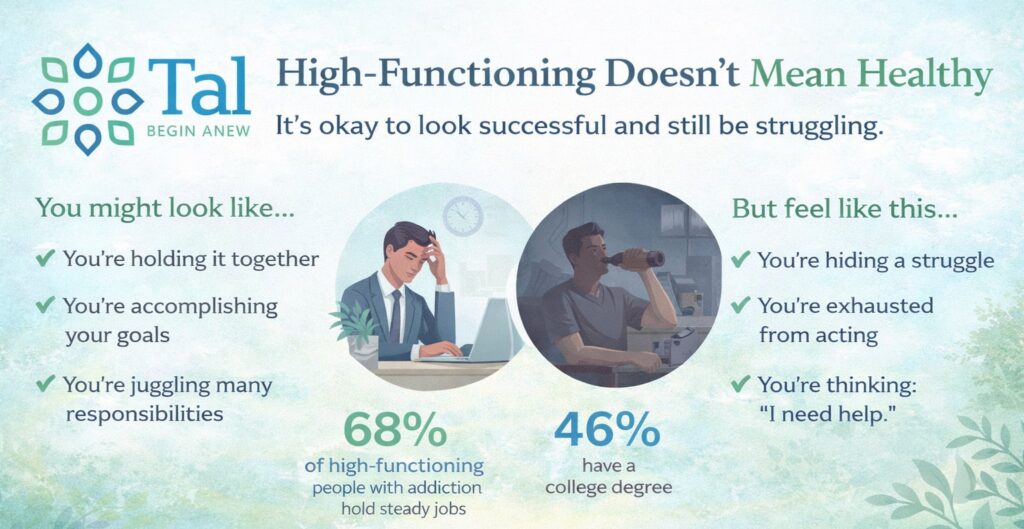
You’ve mastered the art of holding it all together. The clients still get their deliverables. The kids get dropped off. The group chat still thinks you’re the funny one. But behind that high-functioning exterior is a private negotiation you’ve been losing for months—maybe years.
And when you finally walk into an intensive outpatient program, no one is calling you a failure. They’re calling you brave.
You Can Be Successful and Still Be Struggling
Nobody talks about the quiet kind of suffering. The kind that lives between back-to-back meetings, on the way home from the gym, or in the bottle hidden behind the vitamins. The world rewards high-functioners. Your ability to push through, to not let anything slip—that’s made you look invincible.
But being able to function isn’t the same as being okay. It just means your pain wears a nice suit.
You don’t need to blow up your life to need help. You just need to admit that “functioning” is costing you more than it gives back.
High-Functioning Doesn’t Mean Healthy
The lie we tell ourselves is: “If I were really an addict, I’d be losing everything.” But addiction isn’t always dramatic. It can be methodical. Quiet. Well-organized. You can schedule it into your calendar.
And that’s what makes it so hard to name.
You’ve probably said things like:
- “It’s just how I unwind.”
- “I’ve earned this.”
- “It’s not that bad—I’m not out of control.”
But deep down, you know. You’re calculating when you can have your next drink. You’re hiding things. You’re getting really good at pretending—and it’s exhausting.
What Happens When You Walk Into IOP?
Let’s get something straight: walking into an IOP isn’t a confession of failure. It’s a declaration that you’re done performing pain.
At Tal Behavioral Health’s Intensive Outpatient Program in Beachwood, Ohio, you don’t get stripped down or talked down to. You get met where you are—by people who understand that looking “fine” doesn’t mean you’re okay.
IOP gives you structure without stripping your life. You attend several days a week, usually in the evening, so you can keep working, parenting, living. It’s treatment that respects your life while helping you build a better one.
You’ll work on:
- Understanding your patterns (without judgment)
- Rebuilding boundaries (with actual tools)
- Learning how to stay sober (or healthier) without feeling like you’re losing your mind or identity
- Connecting with others who get it—without having to prove anything
Real People, Real Pressure, Real Relief
The biggest surprise in IOP? You’re not the only one who had a double life.
There’s a CFO who drank in the garage after bedtime. A nurse who stole pills from her own cabinet. A dad who crushed every sales goal but cried in the car before school pickup.
High-functioning addiction isn’t rare. It’s just rarely talked about.
But in that group room, you finally exhale. You’re not the exception. You’re not broken. You’re just tired—and now, you’re doing something about it.
Why Now Might Be the Right Time
There’s never a “perfect” moment to start treatment. But there is honesty. And if you’re reading this, that moment has already started.
You’re not waiting for a rock bottom. You’re interrupting the slide before it takes more.
Every day you postpone help is a day you stay stuck in the loop: perform, cope, hide, regret, repeat. IOP is the off-ramp.
It’s not about being dramatic. It’s about being done.
The Fear of What People Will Think
You’ve built a reputation. You’re respected. You’re not trying to become gossip.
Here’s what most people don’t realize: you don’t have to broadcast your healing.
An intensive outpatient program is discreet. Flexible. It doesn’t demand that you leave your job or make an announcement. It just asks you to show up—for yourself.
And if anyone does find out? You’re not the person who “had a problem.” You’re the one who did something about it.
That’s strength. That’s ownership. That’s recovery on your terms.
What You Might Feel After the First Week
Raw. Relieved. Scared. Seen.
It’s okay if the first few days feel disorienting. You’re finally feeling what you’ve been numbing. But that’s also where the power is. IOP isn’t just a crash course in sobriety—it’s a return to yourself.
You start remembering what it’s like to wake up without shame. To laugh without being buzzed. To connect without performance.
It’s not always easy. But it’s real. And it’s worth it.
You Don’t Have to Hit Bottom to Choose a Better Life
You’ve probably spent years convincing yourself that as long as you don’t mess up too badly, things are fine.
But what if “fine” isn’t good enough anymore?
You can want more—more peace, more presence, more honesty—and still be successful. You can be grateful and still want help. You can look fine and still be allowed to say, “I’m not okay.”
That’s not weak. That’s brave.
And that’s exactly what our intensive outpatient program in Beachwood, Ohio is here for.
FAQ: Intensive Outpatient Program for High-Functioning Adults
Do I have to stop working to attend IOP?
No. That’s one of the key benefits of IOP. Most programs, including ours at Tal Behavioral Health, offer flexible evening hours so you can attend without disrupting your job or family schedule.
What’s the difference between IOP and inpatient rehab?
Inpatient rehab requires you to stay at a facility full-time. IOP allows you to live at home while attending structured therapy several times a week. It’s a good fit for people who need support but can still manage day-to-day responsibilities.
Will my insurance cover IOP?
Many insurance plans do cover intensive outpatient treatment. Our team at Tal Behavioral Health can help you verify your benefits confidentially and guide you through the next steps.
Is IOP just group therapy?
No. While group sessions are part of the program, you’ll also have access to individual counseling, education sessions, and relapse prevention tools—all tailored to your specific needs.
What if I’m not sure I’m “bad enough” for treatment?
If you’re asking that question, it’s a sign something’s off. You don’t need to wait for a crisis to ask for help. IOP is designed for people who still have things “together”—but know they’re struggling inside.
📞 Take the Step That Changes the Story
Call (216) 480-4860 or visit to learn more about our Intensive Outpatient Program services in Beachwood, Ohio. You don’t have to hit bottom to choose something better. You just have to stop pretending it’s not hard.