
You’re still getting everything done. Work doesn’t slip. Bills get paid. You show up when people expect you to.
But underneath that consistency, something feels off. Heavier. Slower. Harder than it used to be.
If you’ve found yourself searching for something like addiction help without rehab, it’s probably not random. It usually shows up right around the point where holding everything together starts to cost more than it should.
You’re Functioning—But It’s Taking More Out of You
There’s a version of you that still performs well.
That version answers emails, meets deadlines, keeps conversations light, and knows how to appear “fine.”
Then there’s the version of you behind all that effort—the one who feels drained before the day even starts.
High-functioning people don’t fall apart in obvious ways. They stretch themselves thinner and thinner until everything feels like effort.
What used to feel automatic now feels managed.
And that difference matters.
The Exhaustion Isn’t Just Physical
It’s easy to assume you’re just tired.
But this kind of exhaustion is layered.
It’s mental—constantly calculating how much is too much, how to pace yourself, when you can finally relax.
It’s emotional—feeling disconnected from moments that should feel good.
It’s internal—carrying a quiet awareness that something isn’t sustainable, even if you can’t fully explain why.
A lot of people describe it like this:
“Nothing is falling apart… but nothing really feels right either.”
That in-between space can be harder than a crisis because it’s easier to ignore.
You’ve Learned How to Compensate—And It’s Catching Up
High-functioning individuals are often highly adaptive.
You’ve figured out how to:
- Push through low energy
- Smooth over mood shifts
- Keep routines intact even when motivation drops
- Use substances or habits to regulate stress without it being obvious
From the outside, it looks like resilience.
From the inside, it can feel like constant management.
And over time, the system you’ve built to “keep things together” starts to wear you down.
There’s a quiet moment many people hit where they think:
“I can keep doing this… I just don’t know if I want to.”
Why You Haven’t Reached Out Yet
It’s not denial in the way people usually think about it.
It’s more nuanced than that.
You might not relate to the typical image of addiction or needing help. You’re not missing work. You’re not in crisis. You haven’t “lost everything.”
So it becomes easy to minimize what you’re feeling.
You tell yourself:
- “It’s not that bad.”
- “I can handle it.”
- “Other people have it worse.”
And all of that might be true.
But it doesn’t mean you’re okay.
You Don’t Need to Break Down to Deserve Support
There’s a misconception that support is only for people at their worst.
In reality, some of the most effective care happens before things escalate.
You don’t need to wait until your life is disrupted to justify getting help.
You’re allowed to want:
- More clarity
- More energy
- More control over your choices
- Less internal noise
That alone is enough.
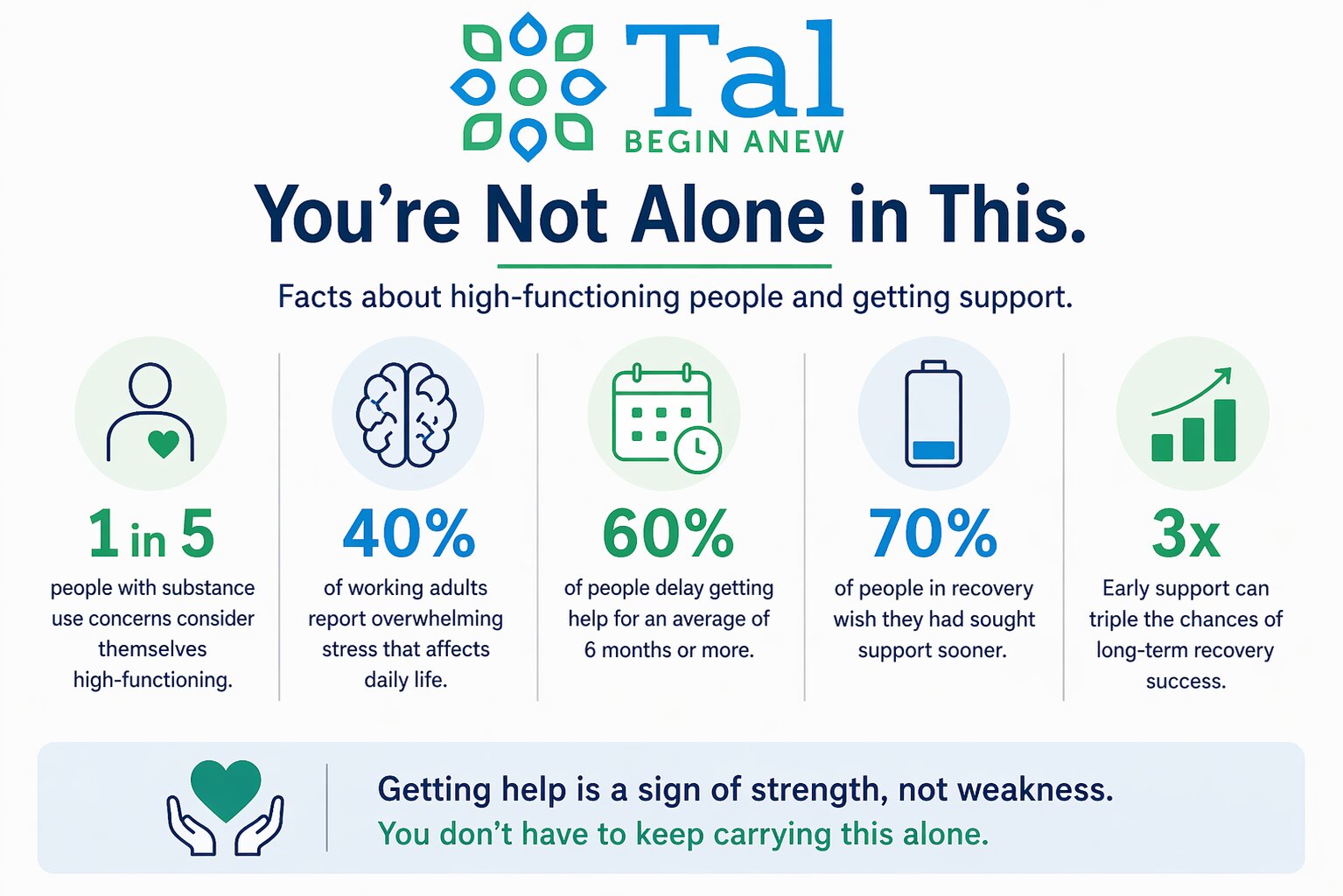
What Support Can Look Like Without Leaving Your Life Behind
For people in your position, the idea of stepping away completely—pausing work, leaving responsibilities—can feel unrealistic.
That’s where structured, ongoing care becomes important.
Not all support requires you to disappear from your life.
There are options designed for people who need consistency and depth without full separation from their daily responsibilities.
This kind of care often includes:
- Several sessions throughout the week
- Individual and group support
- Practical strategies for stress, triggers, and emotional regulation
- Accountability that fits into your schedule
It’s not about removing you from your world.
It’s about helping you stay in it without burning out.
The Risk of Waiting Too Long
This stage can last a long time.
People can function at this level for months—sometimes years.
But the cost tends to increase slowly:
- Your baseline stress rises
- Your tolerance for discomfort lowers
- Your reliance on coping habits grows
- Your sense of control starts to slip
It doesn’t always collapse dramatically.
Sometimes it just becomes harder and harder to feel like yourself.
That’s usually the point where people wish they had addressed it earlier.
You Might Be Closer to Needing Support Than You Think
You might be dealing with more than “just stress” if:
- You think about cutting back or stopping—but don’t follow through
- You rely on something (alcohol, substances, behaviors) to unwind most days
- You feel mentally exhausted even after rest
- You’re more irritable or withdrawn than you used to be
- You feel like you’re “on” all the time and don’t know how to turn it off
None of these make you broken.
They just signal that something needs attention.
Getting Help Doesn’t Have to Be a Big, Public Decision
One of the biggest barriers is the idea that seeking help has to be dramatic.
It doesn’t.
You don’t have to:
- Tell everyone
- Label yourself
- Make a long-term commitment right away
You can start with a conversation.
You can ask questions.
You can explore options quietly and decide what fits.
If you’re in the area, some people begin by looking into options for treatment or support in Cleveland or nearby areas like support in Shaker Heights. Sometimes just knowing there are flexible options close to home makes it easier to take that first step.
A Different Way to Think About Change
You don’t have to frame this as “fixing a problem.”
You can frame it as reducing the weight you’ve been carrying.
Because that’s what this really is.
Not failure. Not weakness.
Just too much, for too long, without enough support.
And support exists in forms that don’t require you to step away from your life completely.
Frequently Asked Questions
Do I have to identify as an “addict” to get support?
No. Many people seek support before they ever use that label—or never use it at all. What matters is how you’re feeling and whether your current patterns are sustainable.
Will I have to stop working or pause my responsibilities?
Not necessarily. There are structured care options designed specifically for people who need support while continuing to work, care for family, or maintain daily routines.
What if I’m not “bad enough” for treatment?
This is one of the most common concerns. If something feels off, that’s enough reason to explore support. You don’t need to reach a certain level of severity to deserve help.
Is this confidential?
Yes. Seeking support is private. You can ask questions, explore options, and move forward at your own pace without it becoming public.
What happens if I reach out?
Usually, it starts with a conversation. You’ll talk through what’s been going on, what you’re feeling, and what kind of support might make sense. There’s no pressure to commit immediately.
If any part of this felt familiar, it might be time to look a little closer at what support could look like for you.
Call 216-480-4860 or visit our intensive outpatient program services in Beachwood, Ohio to learn more about our intensive outpatient program services in Beachwood, Ohio.