
A father recently told us something that stayed with us.
“I kept waiting for a disaster because I thought that was the only thing that would make my son accept help.”
His son was twenty years old.
For a while, things seemed to be improving. Then the old patterns started returning. Missed classes. Missed work shifts. Excuses that didn’t quite add up. Long stretches of silence followed by promises that everything was fine.
As a parent, those moments can feel impossible to navigate.
Part of you wants to trust them.
Part of you knows something is wrong.
And somewhere in between, you’re left wondering what kind of help actually makes sense.
Many families begin searching for answers during this stage. They know weekly therapy may not be enough. They aren’t sure whether their loved one needs live-in treatment. They’re simply looking for a path that offers more support without completely removing someone from everyday life.
That’s often when they begin learning about structured daytime treatment programs and how they fit into the recovery journey.
If you’re the parent of a young adult who has started using again, this article is for you.
Because recovery is often very different from what families expect.
Most Parents Think Treatment Means Starting Over
One of the biggest misconceptions we hear is that seeking additional support means previous progress was wasted.
Parents often say things like:
“We’ve already tried treatment.”
“We thought things were getting better.”
“I can’t believe we’re back here again.”
Those feelings are understandable.
But recovery rarely works in a straight line.
Think about learning any difficult skill.
A person doesn’t master it after one lesson. They practice. They struggle. They improve. They make mistakes. Then they continue learning.
Recovery often follows a similar pattern.
When someone begins using again, it doesn’t erase everything they learned during previous periods of sobriety or treatment.
The coping skills, self-awareness, education, and insight are still there.
The goal is helping them reconnect with those tools before the situation becomes more serious.
Why Young Adults Often Need More Support Than They Admit
The twenties can be a complicated decade.
People are expected to act independently while still figuring out who they are.
Many young adults are balancing work, school, relationships, financial stress, and uncertainty about the future.
When substance use enters the picture, those challenges can become even harder to manage.
Parents often see the warning signs before their child does.
You may notice changes in motivation.
You may notice isolation.
You may notice increasing defensiveness whenever concerns are raised.
Meanwhile, your son or daughter may genuinely believe they have everything under control.
This disconnect creates enormous frustration for families.
The challenge isn’t convincing someone they’re a bad person.
The challenge is helping them recognize they may need additional support.
More Structure Doesn’t Mean Less Freedom
This is one of the most important ideas for families to understand.
Many people hear the word “treatment” and immediately imagine losing freedom.
They picture being separated from family, work, and normal life.
The reality is often much different.
Some adults need a level of care that provides consistent support throughout the week while still allowing them to return home each day.
For many people, that balance becomes an important part of recovery.
They receive therapeutic support, accountability, education, and skill-building while remaining connected to the people and responsibilities that matter most.
Instead of putting life completely on hold, they learn how to rebuild life while receiving help.
For some families, this realization creates an enormous sense of relief.
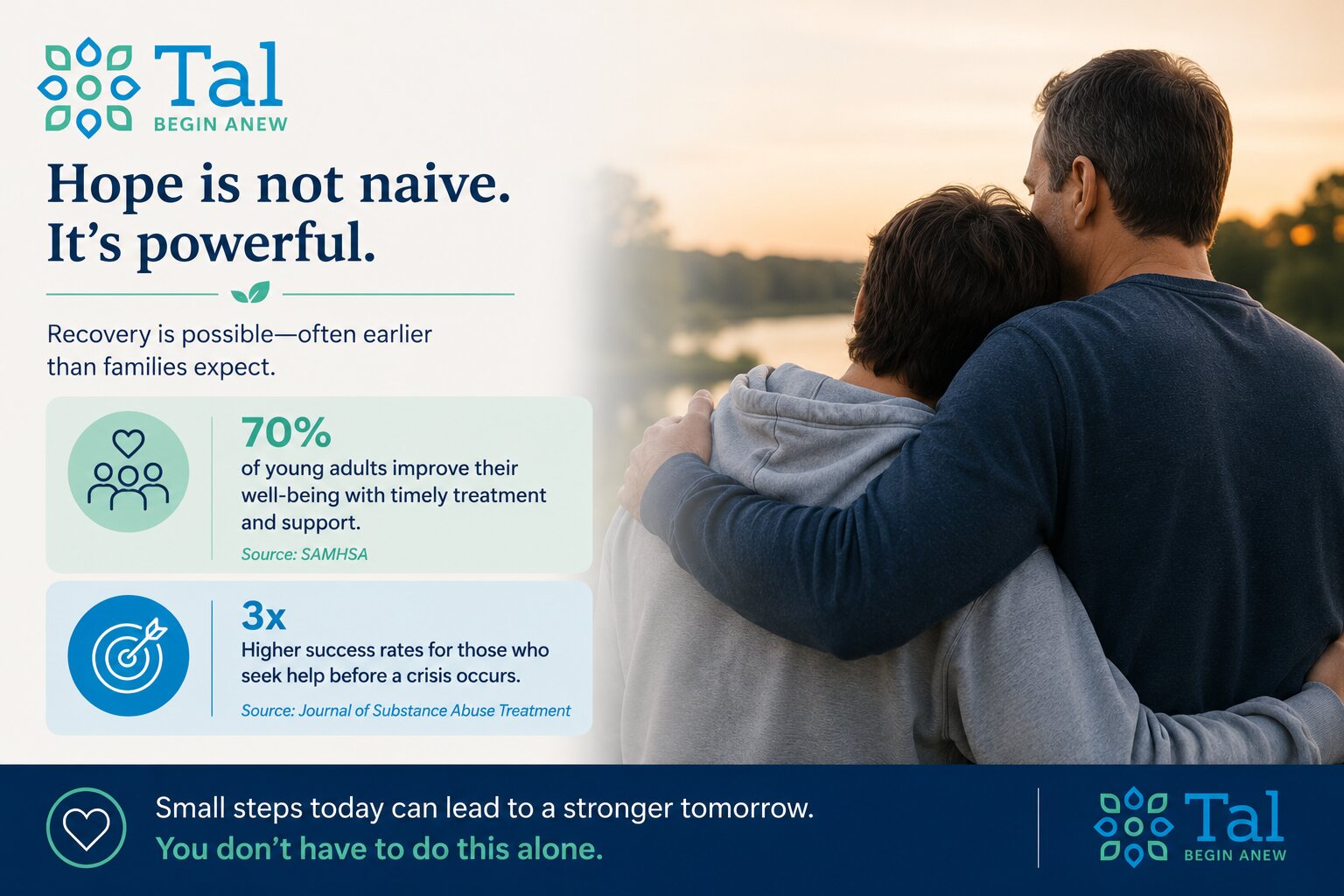
Recovery Usually Starts Smaller Than Parents Expect
Parents often hope for a dramatic breakthrough.
A heartfelt conversation.
A sudden realization.
A moment where everything finally clicks.
Those moments happen occasionally.
More often, recovery begins quietly.
A young adult starts showing up consistently.
They become more honest about what they’re experiencing.
Their sleep improves.
Their mood stabilizes.
They begin participating in family conversations again.
They start keeping commitments.
None of these changes seem life-changing on their own.
Together, however, they become the foundation for larger transformation.
Recovery is rarely one giant step.
It’s usually hundreds of small steps taken in the same direction.
What Success Actually Looks Like
Many families define success as complete sobriety forever.
While long-term recovery is certainly the goal, focusing only on the finish line can make it difficult to see progress along the way.
Success often looks like:
- Increased accountability
- Better communication
- Greater emotional awareness
- Improved coping skills
- Consistent attendance in treatment
- Healthier relationships
- More stability at work or school
- Reduced crisis situations
These victories matter.
They’re often the building blocks that support long-term recovery.
We’ve seen adults arrive feeling hopeless, ashamed, and convinced nothing would help.
Months later, those same individuals were reconnecting with family, returning to work, rebuilding trust, and creating futures they once thought were impossible.
The transformation wasn’t magic.
It was the result of consistent effort supported by the right level of care.
Parents Need Support Too
When a child struggles with substance use, parents often put their own needs aside.
They become investigators.
Problem-solvers.
Crisis managers.
They spend years worrying, researching, monitoring, and trying to prevent the next setback.
Eventually, many become exhausted.
Some parents find themselves checking their phone constantly.
Others struggle to sleep.
Many experience anxiety every time their child doesn’t answer a call or text.
These reactions are understandable.
Loving someone through addiction is emotionally demanding.
One of the most overlooked parts of recovery is helping families heal from the stress they’ve been carrying.
Recovery isn’t only about helping the person using substances.
It’s also about helping the people who love them.
When Hope Feels Dangerous
Many parents stop allowing themselves to feel hopeful.
Not because they don’t want hope.
Because disappointment hurts.
After enough setbacks, hope can start feeling risky.
You begin protecting yourself from future pain.
You lower expectations.
You stop imagining things getting better.
The problem is that hopelessness often creates its own kind of suffering.
We’ve worked with many families who arrived feeling defeated.
They weren’t expecting miracles.
They simply wanted to know whether change was still possible.
The answer was yes.
Not because recovery is easy.
Because people are capable of remarkable growth when they receive the right support.
The twenty-year-old struggling today is not necessarily the same person they’ll be five years from now.
Growth can happen faster than families expect.
There Is Still a Path Forward
If your son or daughter has started using again, you may feel trapped between extremes.
One option feels too little.
Another feels too overwhelming.
The good news is that recovery isn’t limited to all-or-nothing choices.
Many families discover that additional structure provides exactly the support their loved one needs during a difficult period.
For those exploring treatment options in Cleveland or researching support in Shaker Heights, understanding available levels of care can help families make more informed decisions.
Sometimes the best next step isn’t the most extreme option.
It’s simply the right option.
Many people searching for partial hospitalization Cleveland are really searching for something deeper.
They want reassurance that their loved one still has a chance.
They want evidence that change remains possible.
They want to know they haven’t run out of options.
And in many cases, they haven’t.
The story isn’t over.
This chapter may be difficult, but it does not have to define the ending.
Call 216-480-4860 or visit our structured daytime treatment programs to learn more about our programs, php services in Cleveland, Ohio.
Frequently Asked Questions
How do I know if my adult child needs more support than weekly therapy?
If substance use is continuing, responsibilities are being neglected, emotional health is declining, or previous treatment efforts haven’t provided enough stability, a higher level of support may be worth exploring.
Can someone attend treatment and still live at home?
Yes. Many structured treatment options allow individuals to receive significant support during the day while returning home in the evenings.
What if my child doesn’t think they need help?
This is common. Many young adults minimize concerns initially. Having a conversation with treatment professionals can help families understand options and strategies for encouraging engagement.
Is it too late if my child has relapsed multiple times?
No. Many people experience setbacks before achieving lasting recovery. Multiple attempts do not mean recovery is impossible.
Will treatment interfere with work or school?
Every situation is different. Many programs are designed to provide intensive support while helping individuals maintain important responsibilities whenever appropriate.
How can parents support recovery without enabling?
Healthy support often involves setting boundaries, encouraging accountability, participating in family education, and focusing on long-term recovery rather than short-term crisis management.
What makes structured daytime care different from residential treatment?
Structured daytime care allows individuals to receive intensive therapeutic support while continuing to live at home, whereas residential treatment involves living at the treatment facility full-time.