
You didn’t plan to drift. It just started happening.
Maybe it was a missed session—or three. Maybe group felt off lately. Maybe you logged into IOP but didn’t say much. Maybe you haven’t logged in at all.
You told yourself you were just tired, or busy. But the truth is harder to name: the motivation that carried you into treatment doesn’t feel strong enough to carry you through it.
If that sounds familiar, you’re not alone. Many people feel their energy dip mid-treatment. Especially in an intensive outpatient program where life doesn’t stop, and healing is layered and hard.
This isn’t a sign that you’ve failed. It’s a moment worth pausing for—and it’s entirely possible to stay connected, even now.
Start by Getting Honest With Yourself—Gently
The first step isn’t to “get back on track.” It’s to get honest.
Ask yourself, without judgment:
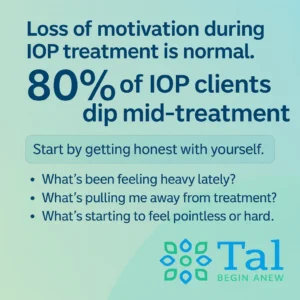
- What’s been feeling heavy lately?
- What’s pulling me away from treatment?
- What’s starting to feel pointless or hard?
You don’t need to fix anything yet. Just notice.
Sometimes, drifting from IOP isn’t about laziness or lack of commitment—it’s about overwhelm, shame, fear, or fatigue. If you can name what’s happening internally, you’ve already taken a step toward re-engagement.
And if you’re thinking, “But I’m so behind,” you’re not. You’re just exactly where you are. That’s a valid place to begin.
Reach Out Before You Feel “Ready”
When motivation fades, the last thing most people want to do is make a call. But reaching out doesn’t require readiness—it only requires honesty.
You can say:
“I’ve been checked out lately. I don’t know what to do about it.”
or
“I think I want to come back, but I feel behind.”
You don’t have to come with a plan. Just let someone know you’re still here, even if just barely.
At Tal Behavioral Health, we’ve worked with people from Beachwood, from Lorain, from Mahoning, and far beyond who’ve taken long pauses mid-IOP. What matters isn’t that you stayed consistent—it’s that you still care enough to reconnect.
Shift the Focus From “Finishing” to “Feeling”
Sometimes, the pressure to “complete” a program gets in the way of actually healing.
If you’ve been stuck in thoughts like:
- “I need to make up for what I missed.”
- “I’m wasting everyone’s time.”
- “I don’t belong here anymore.”
…take a breath.
You’re not in IOP to prove something. You’re here to feel something. To learn. To practice. To show up differently in your own life.
That work isn’t linear. It’s not a pass/fail course. The most powerful sessions might happen after your roughest week. The best insights often come when you least feel “motivated.”
So ask yourself: What part of me still wants to heal?
Start from there—not from guilt.
Expect Your Motivation to Fluctuate (It’s Normal)
Here’s what a lot of people don’t know: most clients in IOP lose motivation at some point. That doesn’t mean the program isn’t working. It means your nervous system is protecting you.
When treatment starts to touch old wounds, fear kicks in. You might feel foggy, restless, or resistant. It might feel safer to back away.
That’s not failure—it’s part of the cycle of healing.
The goal isn’t constant momentum. It’s showing up again and again, even when it’s messy.
And yes, that includes if you live in Stark, or you’re trying to juggle life and care in Medina. Life keeps happening outside of sessions. But that doesn’t mean the work inside has to stop.
Change What Engagement Means for You
You may have started IOP thinking you had to speak up every session, journal daily, or hit every appointment on time.
But healing often looks less tidy than that.
Right now, engagement might mean:
- Sitting through group quietly but present.
- Taking a walk after session to decompress.
- Writing down one thing that resonated—even if you didn’t share.
- Letting your therapist know, “I’m not connecting right now.”
These small acts are engagement. They’re signs you’re still in this, even if your pace has changed.
Some days, “engaged” just means you didn’t quit. That counts.
Talk to Your Team About Adjusting the Fit
Sometimes, what looks like fading motivation is actually something deeper: the structure of your treatment needs to shift.
Maybe you’re ready for a different group dynamic. Maybe you’re craving more one-on-one support. Maybe your schedule has changed and sessions feel like a burden, not a support.
You’re allowed to say, “This format isn’t working right now.”
Your care team wants you to speak up. IOP at Tal is flexible. We’ve adjusted plans for clients who needed a slower pace, more space, different times, or more grounding practices.
This isn’t one-size-fits-all healing. It’s allowed to evolve with you.
You Don’t Have to “Earn” Your Way Back
Missed a few days? A week? More?
You don’t have to apologize your way back into the room.
You’re still welcome.
Whether you ghosted mid-treatment or stepped back intentionally, you don’t owe anyone an explanation. You don’t have to prove your pain. You don’t have to “be ready.”
You can simply say:
“I want to start again.”
That sentence is enough.
And once you return, you might be surprised how natural it feels. Because your spot was always still there.
\FAQs: IOP Re-Engagement and Mid-Treatment Support
Is it normal to want to leave IOP halfway through?
Yes. Most clients hit a wall at some point—especially once the initial crisis has passed. It doesn’t mean treatment isn’t working. It means you’ve reached a place where something deeper may be trying to surface.
What should I do if I’ve missed sessions and feel ashamed?
Start with one honest message. “I’ve missed some sessions and I’d like to come back.” That’s all you need. You won’t be shamed or penalized at Tal. We’re more interested in your return than your absence.
Can I change my IOP schedule if my life circumstances shift?
In most cases, yes. We know life doesn’t stop for treatment. If you need to adjust times, group types, or therapy cadence, speak with your care team. The goal is to make this sustainable.
I live in Stark / Medina—can I still access support if I pause IOP?
Yes. We serve clients in and around Stark, Medina, and Beachwood. If you’re local and need a soft return or partial re-engagement, we’ll work with you to ease back in. You’re not locked out.
How do I know if I’m still benefiting from IOP?
If you’re still thinking about your healing—even while drifting—you’re still in it. Healing happens in subtle ways: noticing triggers, feeling more instead of numbing, wanting to return even if it’s hard. That desire is a sign that something is working.
Thinking about coming back? Start with one step.
Call (216) 480-4860 to learn more about our intensive outpatient program services in Beachwood, Ohio. You don’t need to be ready. You just need to be willing.