
You didn’t fail. You paused.
It can feel awkward, even shameful, to think about going back to a program you left. Maybe you ghosted. Maybe it just got too hard. Maybe life pulled you in too many directions. Whatever the reason, if you’re here reading this, something in you is considering a return to care—and that deserves attention.
At Tal Behavioral Health, we know that healing isn’t linear. Many people step away from an intensive outpatient program and return when they’re more ready. There’s no judgment in that—just an open door. This guide is here to help you gently explore if now might be the time to walk back through it.
1. You’re Thinking About It (Even a Little)
It might start as a passing thought: “Maybe I should call them.” Or a quiet curiosity: “Would they even let me back in?” These small signals matter. They’re your inner voice nudging you toward support.
You don’t have to be certain. You don’t need a dramatic breakdown or a crisis. Sometimes, readiness starts with a whisper, not a shout.
2. Life Looks “Okay,” But Inside It’s Not
You might be getting through the day, checking the boxes—work, family, errands. But under the surface, things feel off. Maybe you’re emotionally flat, anxious, or overwhelmed in ways that are hard to name. You may even feel disconnected from yourself or your people.
These are valid reasons to come back to IOP. Mental health support isn’t just for when life falls apart—it’s for when you feel yourself drifting too far from the life you want to live.
3. You Miss the Support You Had (Even If You Didn’t Love It at the Time)
Maybe you didn’t realize what that group or therapist gave you until it was gone. A place to say the hard thing. A routine that gave your day structure. People who saw past the surface and into your struggle.
Missing those things isn’t weakness—it’s awareness. It’s a sign that part of you felt held, even if another part wasn’t ready to stay. That’s not a contradiction. That’s being human.
4. Shame Is Telling You Not to Come Back
Let’s call it out: shame is loud. It tells you that you blew your shot. That they’ve moved on. That you’re a problem, not a person. None of that is true.
At Tal Behavioral Health, we’ve seen people come back after a few weeks, a few months—even years. You’re not the first to leave. You won’t be the last. And if you’re ready to reconnect, we’re ready to meet you where you are.
5. You’re Wondering If This Time Could Be Different
What held you back last time? Maybe the schedule didn’t work. Maybe you weren’t ready to open up. Maybe you felt overwhelmed by the pace or underwhelmed by the content. That doesn’t mean IOP isn’t for you—it just means your needs might be clearer now.
Returning to an IOP doesn’t have to mean doing the exact same thing. At Tal, we’ll work with you to adjust what you need—because readiness often includes more clarity about what didn’t work the first time.
6. You’re Carrying More Than You Can Handle Alone
It might not be a full-blown crisis, but maybe it’s getting close. You’re tired. The tools you were using don’t seem to be working. The feelings you thought were temporary have stuck around. You don’t want to lose what little stability you have left.
That’s a good time to reach out—not because things are “bad enough,” but because you’re catching it before they get worse. That’s strength. That’s self-awareness. That’s readiness.
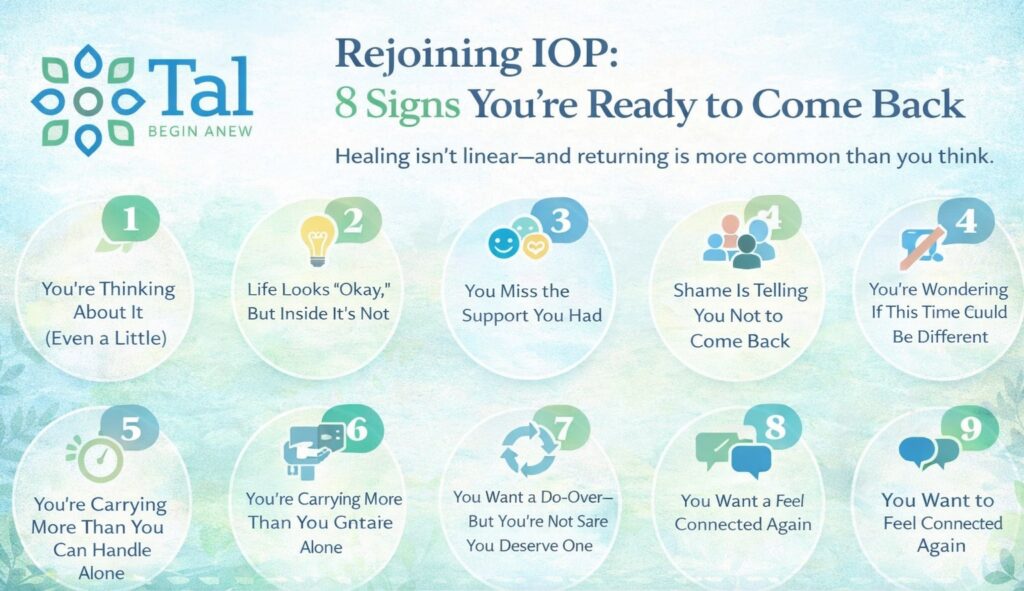
7. You Want a Do-Over—But You’re Not Sure You Deserve One
Let’s be clear: you don’t have to earn your way back into care. You don’t need to prove you’re serious this time or explain why you left.
You just have to show up.
We won’t grill you with questions. We won’t make you start from scratch. We’ll just ask: What do you need right now, and how can we support that?
8. You Want to Feel Connected Again
Leaving an IOP often means losing a sense of belonging. The group, the rhythm, the care—all of it fades, and you’re left trying to manage on your own. Over time, that disconnection can harden into numbness or isolation.
Rejoining IOP can rebuild that bridge. Not just to other people—but to yourself.
Quick Tips: How to Make Re-Entry Feel Easier
- Start with a phone call, not a commitment. Ask questions. Feel it out.
- Don’t apologize for leaving. You don’t need to.
- Share what didn’t work last time. It helps us tailor your care.
- Bring a support person. If it makes walking in the door easier, do it.
- Give it one full week. Let yourself settle before deciding if it’s a fit.
What Re-Entering IOP Could Look Like at Tal
- You’ll meet with a team member to talk about what you need now—not what went wrong before.
- We’ll revisit your goals together. They may be different this time. That’s okay.
- You’ll rejoin a group that’s welcoming and ready for new members.
- You’ll have flexibility and support to help you re-engage at your own pace.
Tal’s intensive outpatient program in Beachwood, Ohio is built on the belief that people change—and that treatment should be ready when they do.
FAQ: Coming Back After Leaving Treatment
Is it normal to leave an IOP and come back later?
Yes. Many people step away and return when they’re in a better place to engage. Healing isn’t linear, and there’s no “one-shot” rule at Tal.
Will I have to start from the beginning?
Not necessarily. We’ll assess where you’re at now, what support you need, and whether resuming or restarting makes the most sense for your care.
Do I need to explain why I left?
No. We’re more focused on how to support you now than what happened before. If sharing helps you process things, that’s welcome—but never required.
What if I’m using again or struggling more than before?
That doesn’t disqualify you. It actually means you probably need support more than ever. We meet people where they are—not where they “should” be.
Can I talk to someone before I decide?
Absolutely. You can call (216) 480-4860 for a no-pressure conversation. We’re happy to walk you through what re-entry could look like.
You Can Come Back—No Shame, No Judgment
It’s not about being ready forever. It’s about being ready now, even just a little. If something in you is stirring, don’t ignore it. You’re not too late. You’re not too far gone. The door is open.
📞 Ready to take the next step? Call (216) 480-4860 or visit Tal’s intensive outpatient program in Beachwood, Ohio. You’re welcome here—again, and always.