
I didn’t think I’d be back here.
Not after the effort. Not after the days I forced myself out of bed. Not after telling people—and myself—that I was finally doing better.
For a while, it even felt true.
Then something shifted.
Not all at once. Not in a way anyone else could see. Just a slow dimming. Like someone quietly turning the lights down in a room you were just starting to feel comfortable in.
If you’re here, searching for something more—something steadier—you probably know that feeling.
And you’re probably wondering if needing more help means something went wrong.
It doesn’t.
The Quiet Slide Back Into Something Heavy
Depression doesn’t always crash back in.
Sometimes it drifts.
You start sleeping a little more… or not enough.
You cancel plans you didn’t even want to make—but still feel guilty about.
You laugh less. Or it feels forced.
And then there’s that low, constant thought:
“This again?”
It’s frustrating in a way that’s hard to explain.
Because you’ve already done work. You’ve already tried.
So this version of struggling feels different.
More personal. More discouraging.
Why This Feels Worse the Second Time
The first time, everything is unfamiliar.
You don’t know what to expect. You’re just trying to survive it.
But this time?
You do know what it feels like to be better.
You’ve had moments of clarity. Energy. Maybe even hope.
So when things start slipping again, there’s a comparison happening in your mind:
- I wasn’t like this a few months ago
- I should be able to get back there
- Why can’t I fix this faster?
That gap—between where you were and where you are now—can feel unbearable.
But it’s also where something important is happening.
You’re noticing sooner.
The Moment You Start Searching Again
Most people don’t talk about this part.
The late-night searching.
The quiet Googling.
Typing things like “day treatment program for depression near me” and then just staring at the results.
Not because you don’t understand what it is.
But because you’re trying to decide if you deserve that level of help again.
If it’s “bad enough.”
If you’re “far enough gone.”
If you’re “allowed” to go back.
That hesitation can keep you stuck longer than anything else.
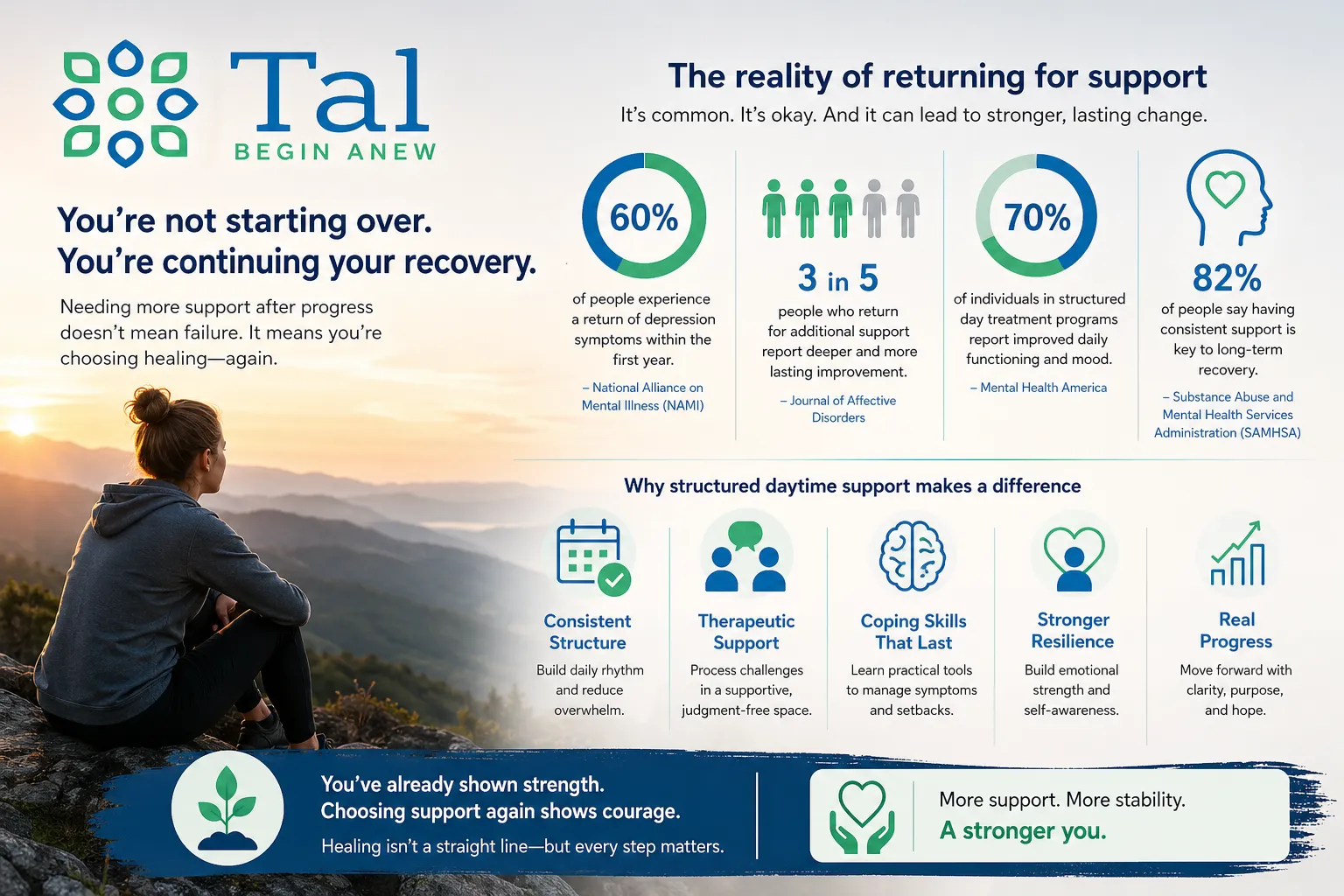
Coming Back for Support Isn’t a Step Back
Let’s be real for a second.
Looking into something like day treatment for depression can feel intimidating.
Not because it’s unfamiliar—but because it’s not.
You know what it means.
You know the commitment.
You know what it asks of you.
And that makes it heavier.
But here’s the part that changes everything:
You’re not coming back as the same person.
You’re coming back with awareness you didn’t have before.
You can recognize your patterns earlier.
You can name what’s happening more clearly.
You’re not guessing—you’re responding.
That’s not starting over.
That’s leveling up your support to match what you’re actually going through now.
The Difference Between Holding It Together and Actually Feeling Better
There’s a version of depression that hides in plain sight.
You go to work.
You answer messages.
You show up for the things you can’t avoid.
From the outside, it looks like you’re okay.
But inside?
Everything feels heavier than it should.
Simple tasks drain you.
Decisions feel overwhelming.
Even rest doesn’t feel like rest.
You’re functioning—but barely.
And that’s where many people stay stuck.
Because it’s not a crisis.
It’s just… constant.
Structured daytime care exists for exactly that space.
Not just for when everything falls apart—but for when you’re quietly struggling to keep it together.
Why More Structure Can Feel Like Relief
There’s a strange kind of relief that comes with admitting:
“I can’t do this alone right now.”
Not because it feels good—but because it’s honest.
Structured care gives your days shape again.
Instead of waking up and negotiating with yourself just to get through basic tasks, there’s a rhythm:
- You show up
- You’re supported throughout the day
- You don’t have to carry everything internally
It creates a container where things can stabilize.
Where you don’t have to pretend.
Where you can actually work through what’s happening instead of pushing past it.
And sometimes, that’s the difference between staying stuck and starting to move again.
The Thought That Keeps You From Taking the Next Step
If you’re hesitating, it’s probably not because you don’t need help.
It’s because of this:
“I should be able to handle this by now.”
That sentence alone keeps people stuck for weeks… months… sometimes longer.
Because it turns needing support into something shameful.
But needing more support doesn’t mean you failed.
It means your situation changed—and you’re responding to it.
That’s not weakness.
That’s awareness.
You’re Not the Only One Figuring This Out Again
It might feel like everyone else moved forward while you’re circling back.
But that’s not the full picture.
A lot of people need different levels of care at different points.
Some need to step back into structured support after a period of stability.
Some realize their initial plan wasn’t enough.
Some just hit a point where things get heavier again.
It’s not unusual.
It’s just not talked about enough.
If you’re around Beachwood and trying to figure out what your next step looks like, you’re not alone in searching for grounded, realistic treatment options in Cleveland or nearby support like support in Shaker Heights that actually meets you where you are now.
What This Moment Might Actually Be
It’s easy to label this as a setback.
But what if it’s something else?
What if this is the point where you stop trying to manage everything—and start actually addressing it?
What if this is where things shift from surface-level coping to deeper stability?
Because that’s often what happens.
Not at the beginning.
Not at the lowest point.
But here—in the middle.
Where you’re aware enough to see what’s happening… and honest enough to do something about it.
You Don’t Have to Prove You Can Do This Alone
Depression has a way of isolating you—even when people are around.
It tells you:
- You’re overreacting
- You should just push through
- You don’t need that much help
But pushing through only works for so long.
At some point, support isn’t optional—it’s necessary.
And choosing it doesn’t make you weak.
It makes you someone who’s paying attention.
FAQs: The Questions You Might Not Be Saying Out Loud
How do I know if I actually need more structured support?
If you’re feeling stuck, overwhelmed, or like you’re barely holding things together—it’s worth exploring. You don’t have to wait until things get worse.
What if I’m still functioning day to day?
Functioning doesn’t always mean stable. Many people seek more support while they’re still managing responsibilities—and that often leads to better outcomes.
Is it normal to come back for help after making progress?
Yes. More common than people admit. Progress isn’t linear, and needing additional support is part of many people’s experience.
What if I feel embarrassed about needing this again?
That feeling is real—but it shouldn’t stop you. Most people in structured care understand this cycle. You’re not being judged.
Will this actually help if I’ve tried therapy before?
Structured care is different. It provides consistent, multi-day support that allows for deeper work and more stability over time.
What if I’m not “bad enough” to need this?
You don’t have to hit a breaking point. If you’re struggling, that’s enough reason to seek support.
How quickly can things improve with the right level of care?
It varies—but many people feel relief simply from not having to manage everything alone anymore. Stability often comes before everything else.
You’re Not Back at the Beginning
It might feel like it.
But you’re not the same person you were before.
You’ve learned things.
You’ve built awareness.
You’ve already experienced what it feels like to move forward.
Even if it didn’t last the way you hoped—it still counts.
And this?
This is just the next layer of the process.
Not a restart.
A continuation.
If something in you keeps saying, “I can’t keep doing this like this,” listen to that.
Call 216-480-4860 or explore our Partial Hospitalization Program in Beachwood, Ohio to learn more.
You don’t have to figure this out alone.