
You’re doing “okay.” You’re showing up.
You haven’t crashed your car. You’re not waking up in jail. You’re not spiraling in a way that your friends would notice.
But under the surface?
Something’s fraying. Something feels off.
Maybe your drinking crept from weekends to weekdays. Maybe your anxiety doesn’t respond to your usual coping tools anymore.
Maybe you’re not sure where the line is between self-control and self-denial—but you know you’re toeing it.
If you’ve ever thought, “I’m not fine, but I’m not falling apart either,” this blog is for you.
You’re not too early to ask for help. And you’re definitely not too far gone.
There’s a kind of support that meets you right where you are—before it turns into a crisis.
At Tal Behavioral Health, we offer structured daytime care designed for this exact space: the quiet middle where functioning people often suffer in silence.
1. Spot the Signs That You’re Running on Empty
Let’s start here.
Not with a diagnosis. Not with labels. Just with honesty.
Here are some signs that your “I’m fine” is covering more than you think:
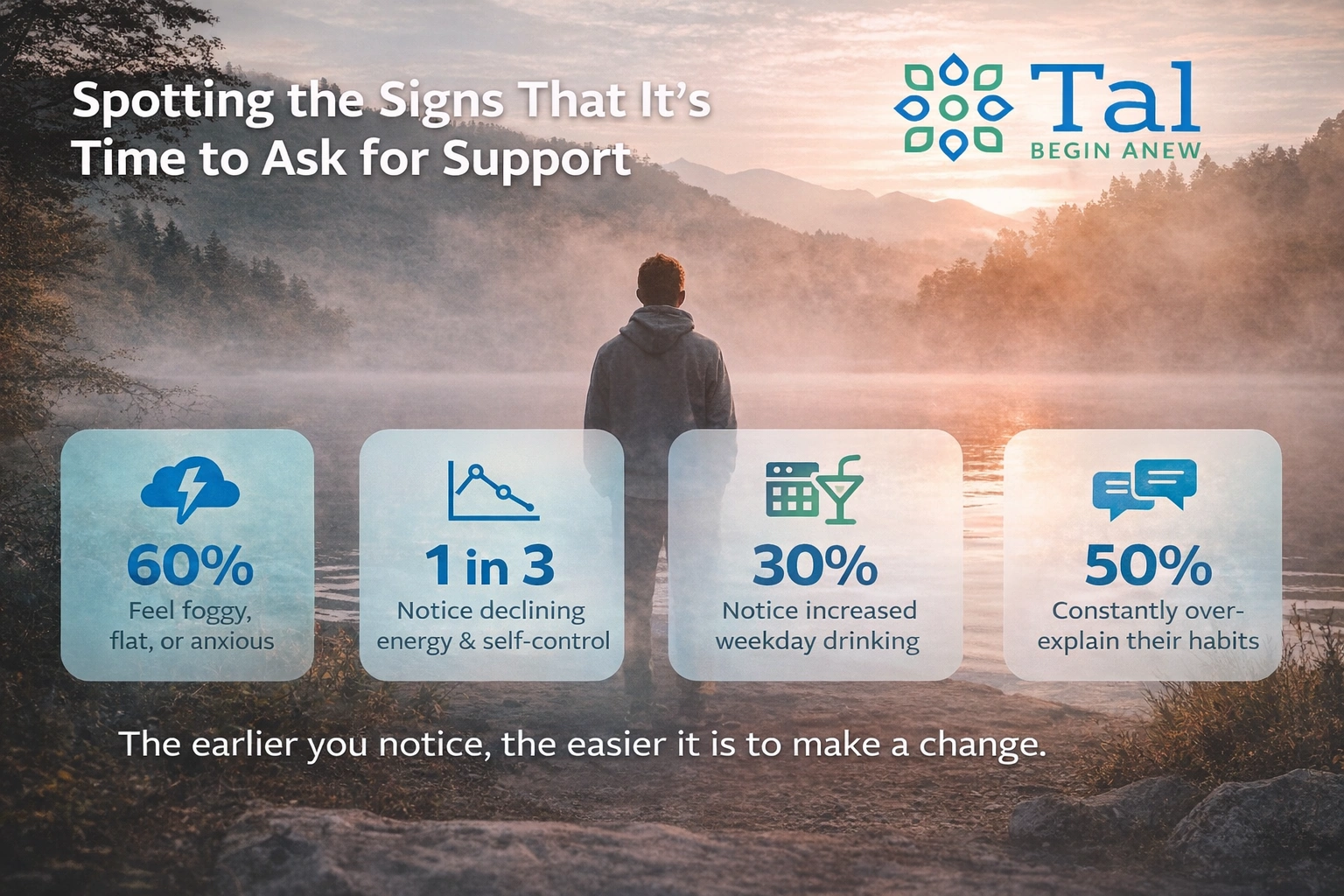
- You over-explain your habits to people—just in case they’re judging
- You make deals with yourself: “Only two drinks tonight. No weed before work.”
- You wake up tired even after sleeping, and go to bed with dread
- You feel like a different person at work than you do at home
- You feel foggy, flat, anxious—or all three
- You’re scared to slow down because you’re not sure what’s underneath the busy
These aren’t failures. They’re signals.
And the earlier you catch them, the easier it is to respond with intention—not urgency.
2. Forget the Binary: It’s Not Rehab or Nothing
A huge blocker for sober-curious folks isn’t the fear of change.
It’s the fear that the only change options are extreme.
That’s because most of us grow up with two cultural images of “getting help”:
- One-hour-a-week therapy where nothing changes
- Full-on live-in rehab that takes you away from your life
So when you’re stuck in that in-between space—aware but not in crisis—it can feel like there’s nowhere to go.
But there is.
Structured daytime care is exactly that middle path. It’s more support than outpatient therapy, but it doesn’t require you to disappear from your life.
It offers clinical help, group work, and accountability while keeping you rooted in your day-to-day.
You don’t have to be falling apart to deserve a system that helps you hold yourself together.
3. Understand the Power of Catching It Now
There’s this myth that people only change after a crash—after they’ve “lost everything.”
But the truth?
The most sustainable change often happens when people decide not to wait for a bottom.
If you’re curious about changing your relationship with substances, your mental health, or the patterns that are keeping you small, you’re in the sweet spot.
You still have energy. You still have self-trust. You’re not rebuilding from rubble—you’re choosing to renovate while the house still stands.
And we can work with that. That’s the best time to start.
4. What Structured Daytime Care Actually Looks Like
This is where a lot of people go quiet. They say, “Okay, but what is it? What does it actually look like?”
At Tal, structured care means:
- Multiple therapy sessions each week, so things don’t get buried
- A built-in rhythm, so recovery doesn’t feel like a side hustle
- Mental health support, because anxiety and depression are often part of the mix
- Group connections, so you’re not thinking, “Am I the only one?”
- Gentle accountability, so you’re not doing it all alone anymore
- A team that listens, even when you’re still figuring out what you need
This isn’t a bootcamp. It’s not about labeling you. It’s about making your life easier, lighter, steadier.
For folks near Northeast Ohio, we offer this care in Cleveland and surrounding areas, so support doesn’t mean uprooting your life—it means anchoring it.
5. If You’re Asking, You’re Ready Enough
One of the sneakiest lies your brain will tell you is this:
“You’re not ready. You don’t really need help. You’ll look dramatic if you sign up for something like this.”
Here’s the truth:
If you’re asking whether support could help, that’s enough reason to check it out.
You don’t need to know how bad it is.
You don’t need to justify your struggles with a disaster story.
You just need to want something different.
Structured support isn’t just for people in freefall. It’s for people like you—aware, thoughtful, tired of treading water.
6. You Don’t Need a Label to Start Healing
Maybe you’re unsure if you even “qualify” for this kind of help.
You don’t think you’re addicted. You’ve never been diagnosed. You’re just… struggling.
That’s enough.
At Tal, we don’t ask people to fit a box before we take them seriously.
We look at function. Fatigue. Feeling stuck. Self-medication.
We look at you—not your label.
This is your life. You don’t have to hit a breaking point to earn support.
7. Give Yourself Permission to Pause and Rebuild
It’s easy to minimize your own needs when things haven’t “gone off the rails.”
But quiet suffering is still suffering.
And burnout doesn’t make a loud entrance—it sneaks in slowly until you can’t remember the last time you felt genuinely rested or clear.
A structured care plan offers space to pause, recalibrate, and reenter your life with more clarity and less chaos.
And that’s not weak. That’s strategic.
Frequently Asked Questions
What if I’m not sure I “need” something this structured?
That’s okay. The intake process includes assessment and conversation. We help you figure out what level of support matches what you’re actually carrying—not just what you think you should be able to handle.
Will this disrupt my job or daily routine?
Structured care is intensive—but flexible. Many clients coordinate with employers or shift responsibilities for a short window to prioritize wellness. Most find that the temporary investment is worth the long-term clarity.
Do I have to commit to full-on sobriety?
No. We work with people at all stages—sober curious, newly abstinent, and long-term in recovery. Your goals shape your plan. We don’t prescribe identity. We co-create support.
Is this covered by insurance?
Often, yes. We work with many plans and can walk you through what coverage may look like. You won’t be left guessing.
How is this different from weekly therapy?
Weekly therapy can be a great start—but if you need more intensity, more structure, or more community, structured daytime care offers a container that accelerates growth. It doesn’t replace therapy—it deepens it.
You Don’t Have to Be in Crisis to Choose Change
You’re not too early. You’re not too “functional.” You’re not being dramatic.
You’re paying attention—and that’s a powerful place to begin.
If you’re ready for more than just coping…
If you’re tired of the quiet tug-of-war with your habits, your mental health, your “okayness”…
We’re here.
Call 216-480-4860 to learn more about Partial Hospitalization Program in Cleveland, Ohio. You don’t need a breakdown to start rebuilding. You just need to say, “I want something better.” We’ll take it from there.