
Sometimes, starting isn’t the hardest part. Coming back is.
If you left an intensive outpatient program (IOP) early—whether it was after one week or one month—it can be hard to imagine returning. You might feel embarrassed. Disappointed. Unsure if you’re even allowed back.
Maybe you didn’t feel ready. Maybe it got overwhelming. Maybe life pulled you in too many directions. Whatever happened, you don’t owe anyone a perfect explanation.
What you do deserve is support that meets you where you are now—not where you were then.
This guide can help you figure out if trying IOP again makes sense for you—and how to do it without shame, pressure, or starting from scratch.
👉 Learn what Tal’s intensive outpatient program offers.
1. First: You’re Not Alone in Leaving
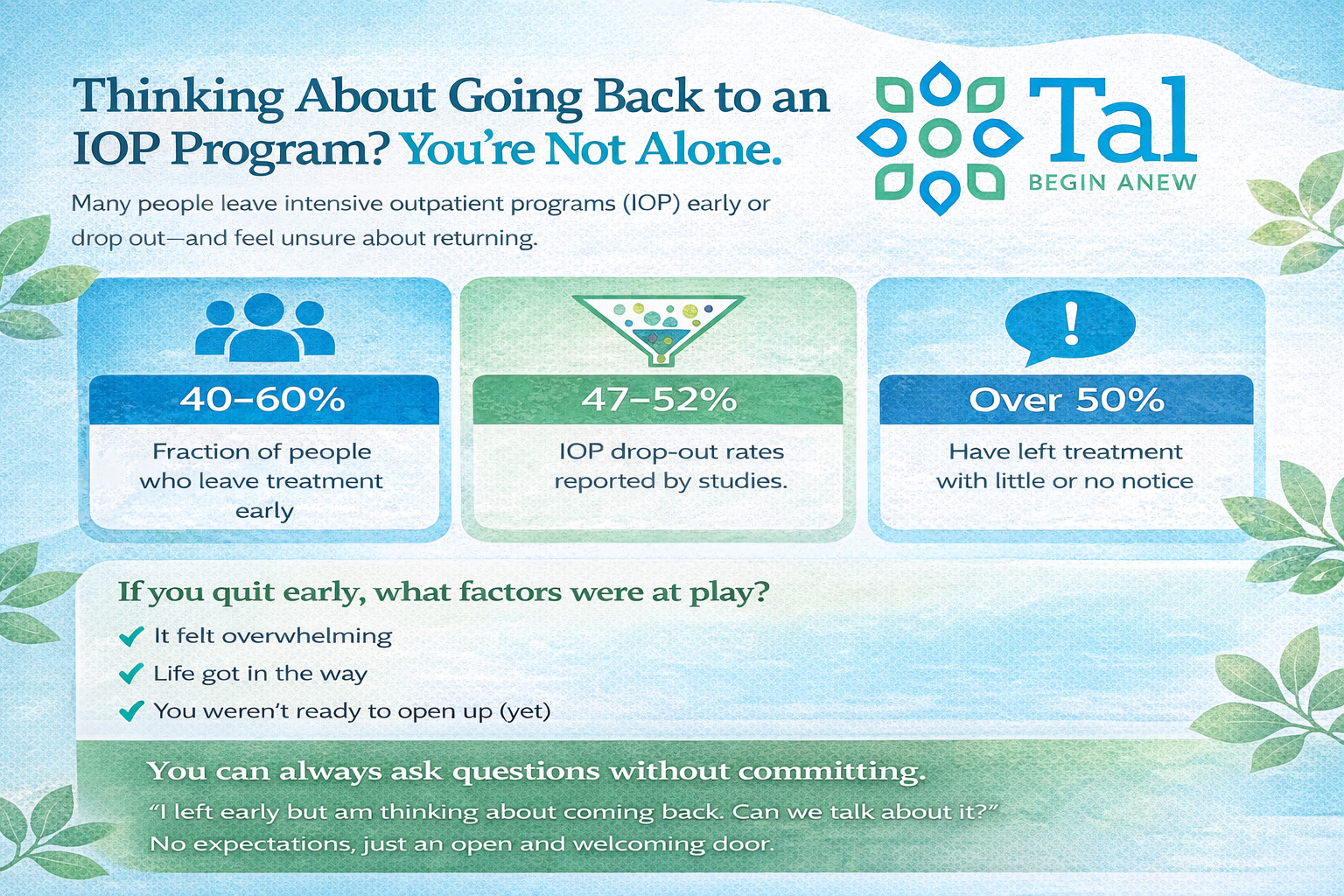
More people drop out of IOP than most think. It’s not always because they didn’t care. Sometimes they just got overwhelmed. Or tired. Or scared. Or numb.
Sometimes group wasn’t clicking. Or the commute was too much. Or showing up got harder with each passing day you didn’t. And at some point, you ghosted.
If that’s you, take a breath.
You’re not broken. You didn’t fail. You left. And that’s part of the story—not the end of it.
2. Ask Gently: What Wasn’t Working?
Before you consider going back, be honest with yourself (without self-blame). What didn’t feel right the first time?
Was it the format—too many people, too much talking, not enough structure?
Was it the timing—work, family, life chaos making it hard to attend consistently?
Was it emotional—you weren’t ready to open up, or it brought up more than you expected?
Or maybe it actually was working… and that scared you more than feeling stuck.
Naming what didn’t work helps you make adjustments this time around.
3. What’s Changed Since Then?
Something led you to this blog. That something matters.
Maybe your symptoms have gotten worse. Maybe the strategies you were using to cope just aren’t helping anymore. Maybe you’ve found yourself circling back to old patterns—and wondering if you need more support than a once-a-week therapy session can offer.
Maybe this time, you’re not looking for a full overhaul of your life. Maybe you just want somewhere you can land, sort through what’s going on, and not feel like you’re doing it all alone.
IOP can still be that—even if it wasn’t before.
4. Coming Back Doesn’t Mean Starting Over
This isn’t school. There’s no attendance grade, no demerits, no “you should’ve finished.” Treatment isn’t a staircase—it’s more like a spiral. You come around to things again and again, each time from a slightly different place.
Even if it’s been months since you left, your time there wasn’t wasted. You learned things. You felt things. You saw that help exists—even if you weren’t ready to fully receive it then.
Coming back means you’re giving yourself another shot with a little more insight, a little more self-awareness, and maybe even a little more courage.
“I left IOP last spring and felt like a flake. But when I called again, the person on the phone didn’t act weird or judge me. They just said, ‘We’re glad you reached out again.’ That was all it took.”
— Outpatient Client, 2023
5. You Can Ask Questions Without Committing
You don’t have to re-enroll tomorrow. You don’t even have to decide today.
You can call and just say, “I was in your IOP last year but left early. I’m thinking about coming back. Can we talk about what that would look like?”
That’s it. That’s allowed. And if you’re worried they won’t remember you—good news: they might not. And even if they do, what they’ll remember is that you showed up at all.
6. This Time, Let It Be a Two-Way Fit
Maybe the IOP you were in wasn’t the best fit for your needs. That doesn’t mean you’re the problem. This time, you can ask for what you need more clearly:
- A different group format
- More 1:1 check-ins
- Later or earlier sessions
- Clearer expectations around attendance
A good provider won’t take that as a burden—they’ll see it as you advocating for yourself.
If you’re near Shaker Heights or Cleveland, support is available that can flex with you—not force you into a mold that doesn’t fit.
7. You Deserve Support That Feels Like Support
Here’s the truth: deciding to try again isn’t a sign of weakness. It’s the opposite.
It means you still believe change is possible—even if you’re scared. It means you’re willing to admit that maybe you don’t want to keep doing it alone. It means the part of you that still hopes for peace, healing, or even just relief—that part is still alive.
You’re allowed to come back. You’re allowed to ask for help again. And you’re allowed to make it work better this time.
Frequently Asked Questions: Trying IOP Again After Leaving
Can I rejoin the same IOP if I left before?
In most cases, yes. Treatment centers like Tal Behavioral Health understand that people leave for all kinds of reasons. Returning clients are usually welcomed back with open arms—not judgment.
Will I have to explain why I left?
Only if you want to. Intake staff may ask what’s different this time to help shape your care plan, but you won’t be forced to justify your past. You’ll be met where you are.
Will I have to start the whole program over?
Not necessarily. If you attended part of the program before, your care team can assess what you’ve already done and tailor a plan that builds from there.
What if I ghosted and feel embarrassed to reach out?
You’re not the only one. Ghosting is common, and no one at Tal will shame you. Just saying, “Hey, I’d like to come back” is enough to start again.
Can I switch to a different location or format?
Yes. If your previous group wasn’t the right fit, talk with staff about other options—including different times, formats, or even clinicians. Your comfort matters.
📞 You’re Allowed to Return
No lectures. No shame. Just a door that’s still open.
Call (216) 480-4860 or visit to learn more about our intensive outpatient program services in Cleveland, Ohio.