There’s a quiet ache that often comes with getting sober—one that no one warned you about. It’s not the withdrawal. It’s not the cravings. It’s the loneliness. After the chaos of active addiction fades, many people in early recovery are left sitting in silence, wondering: Where is everyone? What happens now?
If that sounds familiar, you’re not broken. You’re in a very human part of the healing process. And you don’t have to face it alone.
At Tal Behavioral Health, our Partial Hospitalization Program in Beachwood, Ohio is built for this exact season of life—the messy middle where hope and heartbreak often collide. Below, we answer the most common questions our clinicians hear from people who are newly sober and struggling with that deep, disorienting sense of loneliness.
What Is a Partial Hospitalization Program (PHP)?
A Partial Hospitalization Program is an intensive, structured outpatient treatment option. You attend for most of the day—typically 5 to 6 hours—five days a week. It offers the therapeutic depth of inpatient care but allows you to return home each evening.
Think of it like this: If inpatient treatment is a hospital bed, PHP is a strong pair of walking shoes. You’re still recovering, but you’re starting to move forward, step by step.
In Tal’s PHP, you’ll receive a full schedule of support:
- Group therapy
- Individual therapy
- Medication management (if needed)
- Life skills development
- Relapse prevention tools
- Emotional regulation and trauma-informed care
And perhaps most importantly—you’ll be in community. No pressure to perform. Just permission to be exactly where you are.
Why Does Sobriety Feel So Lonely?
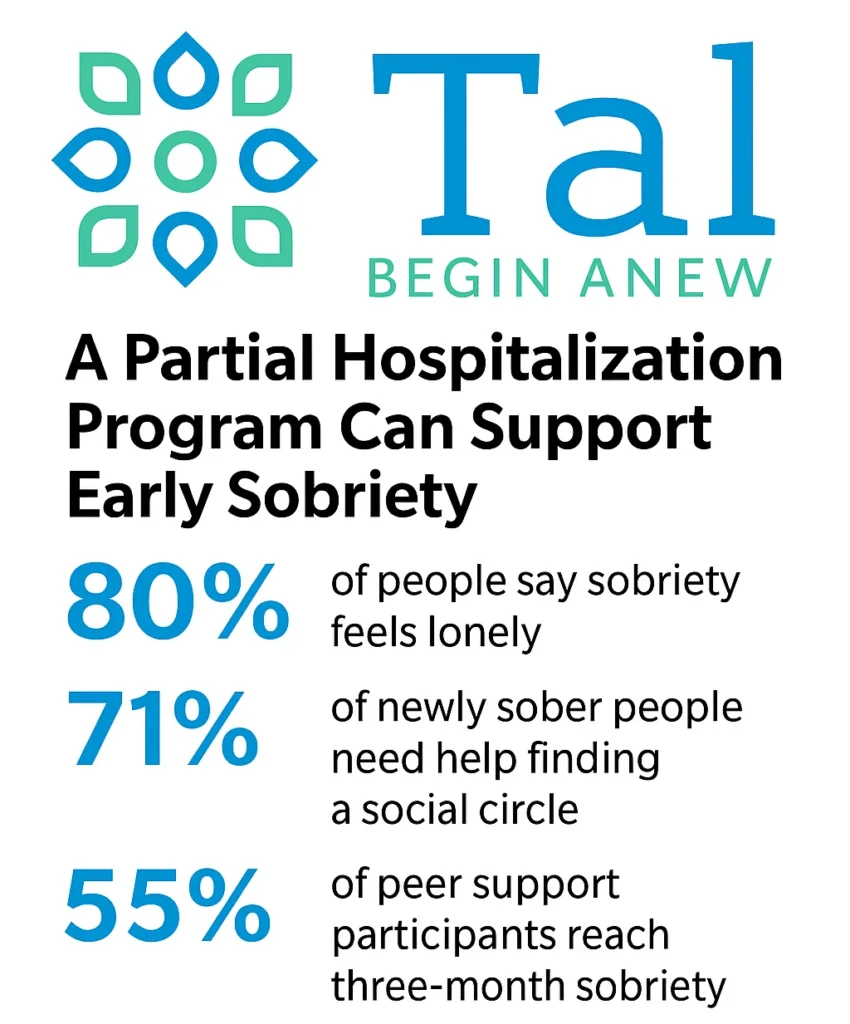
The loneliness of early sobriety is real—and it’s not a sign that something’s wrong with you. Often, it’s the first time you’ve sat with your feelings without numbing, escaping, or distracting yourself. That emotional rawness can be overwhelming.
Also, many people lose social circles when they stop using. Friends who drank or used with you might not understand. Family might be cautiously hopeful or still healing. And if you’ve left inpatient treatment recently, returning home can feel like stepping into a quiet room after weeks of constant support.
That’s where PHP comes in—it helps create a structured, social healing space between inpatient and everyday life.
Will I Be Forced to Share in Group Therapy?
No. You will never be forced to speak before you’re ready. In a well-run PHP like Tal’s, participation is encouraged but never pressured. Many clients spend their first few days just listening—and that’s perfectly okay.
Healing has its own rhythm. Your job isn’t to perform it. Your job is to show up and stay open to the process.
Can PHP Help Me Rebuild a Sense of Belonging?
Yes, and not just through talk therapy. Belonging comes from routine, purpose, and feeling seen. PHP gives you:
- A consistent daily rhythm
- Peer support that doesn’t rely on performance
- Small, repeatable moments of connection
- Clinicians who remember your name, your story, and your strengths
It’s the difference between being alone in a room and being quiet in a room full of people who understand.
What If I Still Feel Like the “Outsider”?
It’s okay if the connection isn’t instant. Sometimes, the people in your group won’t feel like “your people” right away. That doesn’t mean you don’t belong—it just means you’re early in the process.
One of our favorite reminders for clients is this: “You don’t have to fit in to be accepted.” The goal of PHP isn’t to mold you into someone else. It’s to create space for the real you to safely unfold.
What Happens After PHP Ends?
Recovery isn’t linear, and neither is treatment. After PHP, some people step down into an Intensive Outpatient Program (IOP), which offers a few hours of treatment a few days a week. Others transition to weekly therapy or peer support groups.
At Tal, we help you plan this next step based on how you’re doing emotionally, mentally, and physically—not on a preset schedule. There’s no “one-size-fits-all” exit date here. You move forward when you’re truly ready.
How Long Does PHP Last?
Most Partial Hospitalization Programs last between 2 to 6 weeks. At Tal, we regularly check in to reassess what’s working and what you might need next. Some people stay longer. Others step down sooner. What matters most is that your healing feels supported, not rushed.
Can I Work or Go to School During PHP?
Since PHP typically runs during the day, full-time work or school isn’t usually possible at the same time. But this doesn’t mean you’re falling behind. In fact, PHP often helps people stabilize enough to return to work or school with more clarity, emotional regulation, and support tools.
If you need help with FMLA paperwork, scheduling concerns, or school coordination, our team can walk you through those logistics gently and confidentially.
FAQ: Partial Hospitalization Program for Early Recovery
What makes Tal’s PHP in Beachwood different?
We’re not just treating symptoms—we’re supporting the whole person. At Tal Behavioral Health, you’ll find trauma-informed care, individualized treatment planning, and a deeply human team that knows healing isn’t linear.
We also keep group sizes small, so every voice matters—even the quiet ones.
Do I need to have completed inpatient rehab before starting PHP?
Not always. Some clients come to us directly from home if they don’t need medical detox or 24/7 supervision. Others step down from inpatient care. Either path is valid, and we’ll help you determine the safest place to begin.
Is transportation available?
We understand that transportation can be a barrier. Depending on your location and insurance, we may be able to help arrange transportation or offer guidance on community options. Reach out—we’ll do our best to support your access to care.
Can I attend PHP if I have co-occurring mental health issues?
Yes. Many clients in early recovery are also managing depression, anxiety, trauma, or other mental health conditions. Tal’s PHP is dual-diagnosis capable, meaning we’re equipped to treat both substance use and mental health together—because they often go hand-in-hand.
What if I tried a program before and it didn’t work?
Trying again doesn’t mean you failed. It means you’re still fighting for your life—and that takes courage. Every program is different, and every season of healing is different. What didn’t land before might be exactly what helps now.
You’re Allowed to Take Up Space While You Heal
If early sobriety feels like standing in a crowded room where no one sees you—know this: healing isn’t about being the loudest voice or the most “together” person in the group. It’s about being honest, being held, and being allowed to feel whatever’s true for you today.
📞 You don’t have to do this alone.
Call (216) 480-4860 or visit to learn more about our Partial Hospitalization Program in Beachwood, Ohio, Cuyahoga, Summit, Stark. We’ll meet you where you are—and walk with you from there.