
You don’t look like someone who needs help.
That’s exactly why it’s so easy to stay where you are.
You’re still performing. Still delivering. Still showing up in ways that make it hard for anyone—including you—to point to something and say, “This isn’t working.”
But something brought you here.
And if you’re honest, it’s not curiosity. It’s recognition.
The Version of You Everyone Sees—and the One They Don’t
From the outside, your life makes sense.
You’re dependable. Productive. Composed.
You know how to manage pressure, navigate expectations, and keep things moving forward—even when you’re not at your best.
But there’s another version of this that no one sees.
The one that feels constantly “on.”
The one that doesn’t really rest, even when you stop working.
The one that quietly relies on something—just to take the edge off, to slow down, or to keep going.
That version doesn’t get acknowledged.
Because the visible version is still functioning.
And as long as that’s true, it becomes very easy to convince yourself nothing needs to change.
The Story That Keeps You Stuck
High-functioning people don’t ignore problems.
They reframe them.
You don’t say, “I’m struggling.”
You say:
- “I’ve just been under a lot of pressure lately.”
- “This is temporary.”
- “I’ll get back on track next week.”
And maybe you believe that.
Because technically, you are still in control.
But there’s a difference between control and compensation.
And when you start relying on something to maintain that control, it slowly shifts the balance.
Why You Wait Longer Than Anyone Else
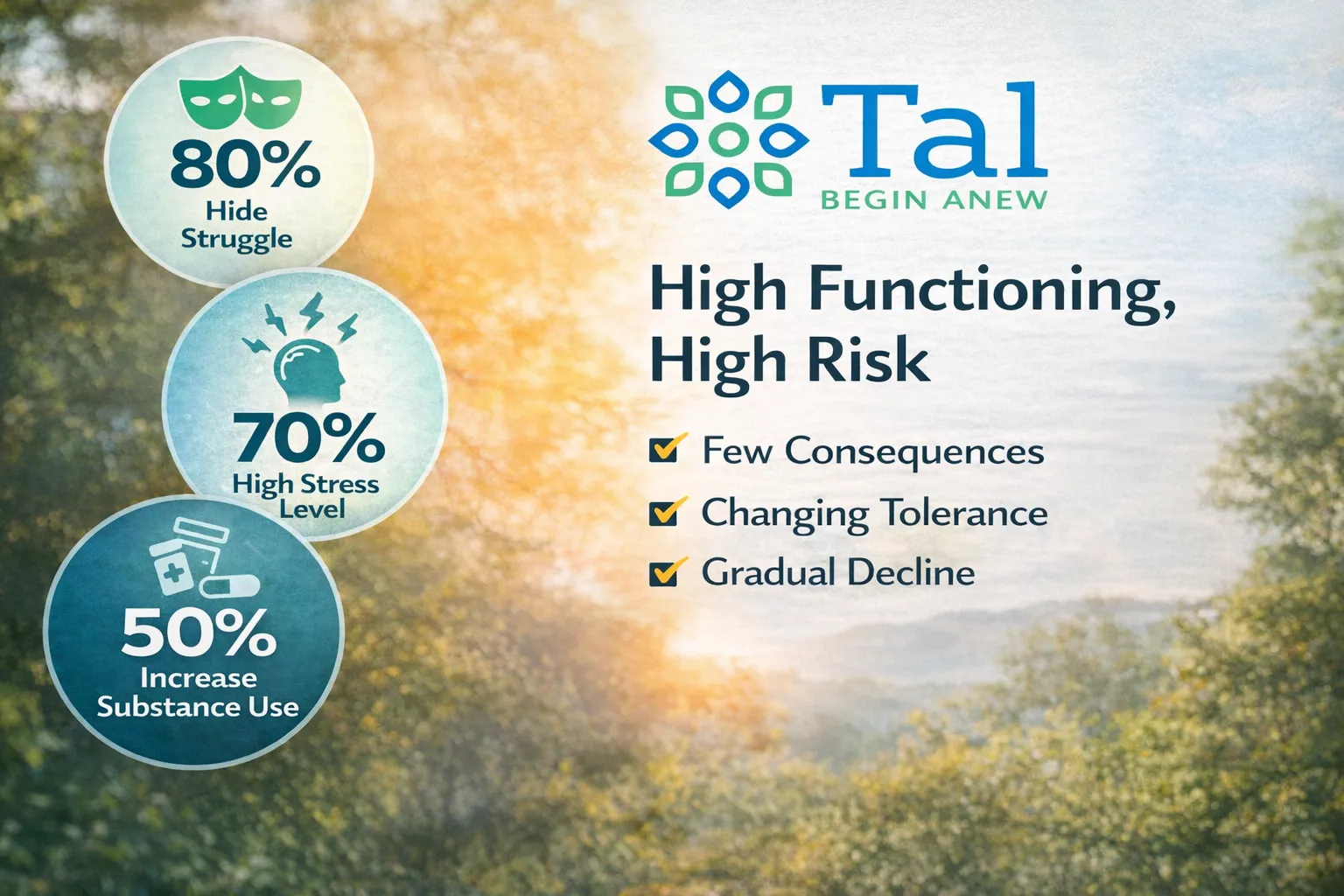
You don’t have external consequences forcing you to act.
No missed responsibilities.
No major fallout.
No moment where everything clearly breaks.
So you keep going.
Because you can.
And that’s the trap.
The absence of consequences doesn’t mean the absence of impact.
It just means the impact is happening quietly.
Internally.
Gradually.
The Slow Drift That Doesn’t Feel Urgent—Until It Does
It doesn’t feel like a crisis.
That’s why it’s so easy to ignore.
But over time, things start to shift:
Your energy feels inconsistent.
Your focus takes more effort.
Your tolerance for stress gets thinner.
You might notice it—but you don’t act on it.
Because nothing is “bad enough.”
Until one day, it is.
Not in a dramatic way.
Just in a way that’s harder to ignore.
The Fear Isn’t About Help—It’s About Losing Control
If you strip everything back, this is where most of the resistance lives.
You’re not afraid of support.
You’re afraid of what stepping into it might mean.
Losing momentum.
Losing control.
Losing the version of yourself that people rely on.
There’s a belief underneath it:
“If I slow down, everything might fall apart.”
But here’s what we see over and over again:
What looks stable from the outside is often being held together with more effort than it should require.
The Moment Clarity Cuts Through
There’s a moment most high-functioning people reach.
It’s not dramatic.
It’s not emotional.
It’s quiet.
It sounds like:
“This isn’t sustainable.”
And once that thought lands, it doesn’t go away.
You can try to push through it.
You can try to outwork it.
But it lingers.
That’s usually when people start exploring options that don’t require stepping away from their life—but do offer real support.
If you’re in that space, you can explore multi-day weekly treatment as a way to get consistent support while still maintaining your responsibilities.
Why Waiting Feels Safer—But Costs More
Waiting feels logical.
It gives you time to “figure it out.”
It allows you to maintain control.
It avoids disruption.
But it also extends the strain.
Because what you’re managing doesn’t stay the same.
It builds.
And the longer it builds, the more effort it takes to keep everything appearing stable.
That cost doesn’t always show up immediately.
But it shows up eventually.
The Reality Behind “I’m Still Handling It”
You probably are.
Handling it.
Meeting expectations.
Maintaining performance.
Keeping things together.
But handling it doesn’t mean it’s working.
It just means you’re capable of carrying more than most people can see.
And at some point, carrying more stops being a strength—and starts becoming a risk.
What Changes When You Stop Carrying It Alone
The idea of support can feel unfamiliar.
Even uncomfortable.
Because it shifts the dynamic you’re used to.
You’re no longer the one holding everything together.
There’s space for something else to step in.
And while that might feel unsettling at first, it often leads to something most high-functioning people haven’t felt in a long time:
Relief.
Not the kind that comes from escaping pressure.
The kind that comes from not having to manage everything by yourself.
For individuals navigating this in Lorain, that shift often starts with a simple realization:
“I don’t have to keep doing this alone.”
You Don’t Have to Hit Bottom to Take This Seriously
This is one of the biggest misconceptions that keeps people stuck.
That something dramatic has to happen first.
It doesn’t.
You don’t need:
- A crisis
- A loss
- A breaking point
To justify change.
You just need to recognize that what you’re doing right now isn’t sustainable.
And that recognition—on its own—is enough.
The Cost No One Sees
From the outside, it still looks like success.
You’re still showing up.
Still achieving.
Still functioning.
But inside, there’s a cost.
Mental fatigue that doesn’t fully reset.
Emotional strain that builds quietly.
A constant sense of being “on” with no real off switch.
And over time, that cost adds up.
Not all at once.
But enough.
What This Really Comes Down To
This isn’t about labels.
It’s not about whether something is “bad enough.”
It’s about sustainability.
Can you keep going like this—long-term—without something giving?
If the answer is no, even quietly, then something needs to shift.
Not everything.
Just something.
FAQs
If I’m still functioning, do I really need help?
Functioning doesn’t always mean things are stable. Many high-functioning individuals are managing a lot beneath the surface. Support can help before things escalate.
Why is it harder for high-functioning people to step in earlier?
Because there are fewer external consequences. Without a clear breaking point, it’s easier to justify waiting—even when things aren’t sustainable.
Will getting support disrupt my work or responsibilities?
Not necessarily. Many people choose options that allow them to continue working while receiving consistent support.
What if I feel like I should be able to handle this on my own?
That belief is common—but it can also keep people stuck longer than necessary. Support isn’t about inability—it’s about sustainability.
How do I know when it’s time to act?
When you start questioning whether what you’re doing is sustainable, that’s usually the moment to consider support.
Is it too early if nothing major has happened yet?
No. In many cases, earlier support leads to better outcomes because it prevents things from escalating.
You don’t have to wait for things to fall apart to take this seriously.
Call (216) 480-4860 to learn more about our Intensive Outpatient Program in Cleveland, Ohio.