
You didn’t think you’d be here again.
Not like this. Not after everything you already pushed through.
And yet—here you are. Sitting with that quiet realization that something slipped. That the version of you who felt steady just a few weeks ago feels… far away.
If you’re reading this, there’s a good chance you’re carrying something heavy right now.
Not just the relapse itself—but what it means.
Or what you think it means.
The Moment It Stops Being “Just a Slip”
It doesn’t usually hit all at once.
At first, it feels manageable.
You tell yourself it’s a one-time thing.
That you can correct it.
That it doesn’t undo everything.
But then something shifts.
The routines you had start to loosen.
The boundaries you built feel easier to cross.
The voice that used to keep you grounded gets quieter.
And eventually, the question shows up:
“Am I actually okay… or am I sliding back?”
That moment—right there—is where many people pause.
Not because they don’t want help.
But because they’re afraid of what asking for it means this time.
If you’re trying to understand what your next step could realistically look like, you can explore structured daytime care as a way to rebuild without stepping completely out of your life again.
What We Actually See When You Walk Back In
From your side, it might feel like failure.
From ours, it looks very different.
We don’t see someone who “messed it up.”
We see someone who:
- Stayed away longer than they once thought possible
- Built skills they didn’t have before
- Is now aware of patterns they couldn’t see the first time
Yes, there’s pain there. Sometimes a lot of it.
But there’s also something else:
Depth.
You’re not walking in as the same person.
And that matters more than you think.
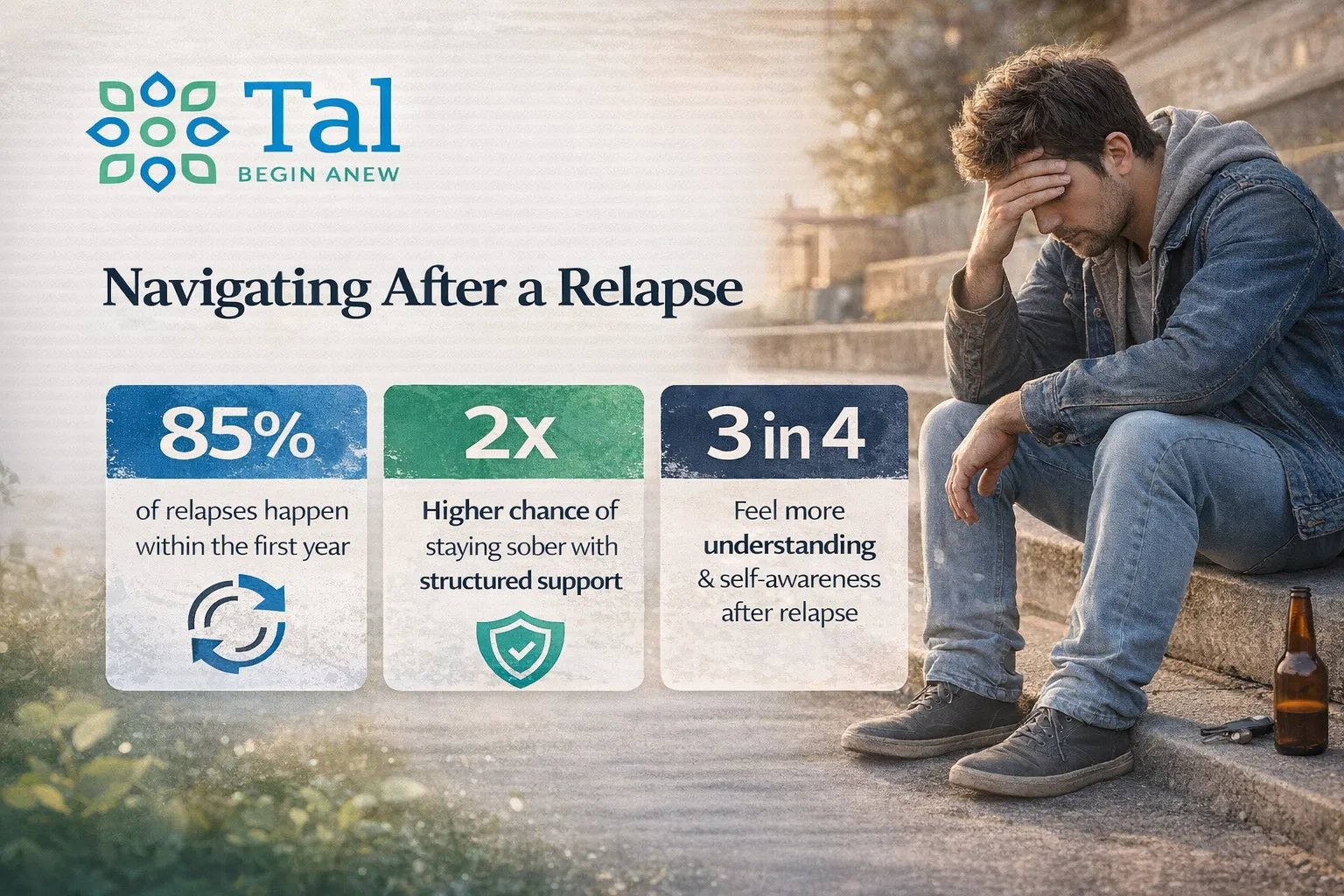
The Weight You’re Carrying Isn’t Just About the Relapse
Most people think the hardest part is what happened.
It’s not.
It’s what you tell yourself about what happened.
The internal conversation gets loud:
“You knew better.”
“You had your chance.”
“You’re right back where you started.”
That voice doesn’t just hurt—it distorts reality.
Because the truth is, you’re not at the beginning.
You’re standing in a place where you understand more than you did before.
And even if it doesn’t feel like it, that’s progress.
Why Coming Back Feels So Much Harder This Time
The first time, there’s uncertainty.
You don’t know what to expect. You don’t know how hard it’s going to be.
The second time?
You remember everything.
You remember the vulnerability.
The discomfort.
The moments where you had to be completely honest in ways you weren’t used to.
And now, you’re being asked to step into that again—while carrying disappointment on top of it.
Of course it feels heavier.
But there’s something most people don’t realize until they experience it:
The second time isn’t about proving anything.
It’s about understanding yourself more clearly.
The Shift From “Trying” to Actually Seeing Yourself
There’s a difference between going through the motions and actually seeing what’s happening inside you.
The first time, you might have been focused on getting through it.
This time, there’s more awareness.
You start to recognize:
- The moments where your thinking shifted
- The situations that quietly pulled you off track
- The emotions you didn’t fully process
This isn’t about being harder on yourself.
It’s about being more honest.
And honesty—real honesty—is where things begin to change.
You’re Not the Only One Who’s Been Here
It might feel like everyone else moved forward and you’re the one who fell behind.
But that’s not how this works.
Many of the people who build something lasting didn’t do it in one straight line.
They came back.
Sometimes more than once.
And every time they did, they carried something new with them.
If you’re considering coming back, you’re not stepping outside the process.
You’re still in it.
For individuals navigating recovery in Mahoning, this is something we see often—people returning with hesitation, but also with a deeper understanding of themselves than they had before.
And that understanding becomes the foundation for what comes next.
This Isn’t Starting Over—It’s Continuing With More Truth
It feels like everything reset.
But look closer.
You’re not the same person who walked in the first time.
You’ve experienced stability before.
You’ve felt what it’s like to show up for yourself.
You’ve seen both sides—what works, and what pulls you away.
That doesn’t disappear.
Even if it feels distant right now, it’s still there.
This isn’t starting over.
It’s continuing—with more clarity than you had before.
Why Structure Matters More After a Slip
After relapse, things can feel off in a way that’s hard to explain.
Not chaotic.
Just… unstable.
Your routines aren’t as strong.
Your footing doesn’t feel as steady.
Your confidence takes a hit.
This is where structure becomes essential.
Not overwhelming. Not rigid.
Just consistent enough to help you find your rhythm again.
A place where:
- Your day has shape
- Support is present whether you feel ready or not
- You don’t have to rely on willpower alone
That kind of support doesn’t fix everything overnight.
But it creates something you can stand on again.
The Part No One Talks About—Relapse Can Make You More Honest
There’s something unexpected that often comes out of relapse.
Honesty.
Not forced honesty. Not performative honesty.
Real honesty.
The kind where you can say:
“I didn’t actually deal with that.”
“I thought I was okay, but I wasn’t.”
“I avoided more than I realized.”
And while that can feel uncomfortable—it’s also powerful.
Because when you can see things clearly, you can actually work with them.
Instead of around them.
The Quiet Strength It Takes to Walk Back In
There’s a version of courage that doesn’t get talked about much.
It’s not loud.
It doesn’t feel confident.
It’s quiet.
It’s the decision to come back even when you feel embarrassed.
Even when you’re not sure how it’s going to go.
Even when part of you wants to avoid it completely.
That’s the kind of courage this takes.
And if you’re even considering that step, it means you still have it.
What We Want You to Know Before You Decide Anything
You don’t have to prove anything to come back.
You don’t have to explain everything perfectly.
You don’t have to wait until things get worse.
You’re allowed to return exactly as you are right now.
Uncertain. Frustrated. Tired. Still trying.
That’s enough.
FAQs
Does coming back mean I failed the first time?
No. It means you’re still in the process. Recovery is not a one-time event—it’s something that unfolds over time, and setbacks are part of that process for many people.
Why does relapse feel worse emotionally than I expected?
Because it often brings up shame and self-judgment. It’s not just about what happened—it’s about the meaning you attach to it. That’s what makes it heavier.
Is it normal to hesitate before coming back?
Yes. Almost everyone feels some level of hesitation. It’s a mix of fear, pride, and uncertainty. That hesitation doesn’t mean you shouldn’t come back—it just means this matters to you.
What’s different the second time around?
Awareness. You’re not starting from zero. You’re coming back with insight, experience, and a clearer understanding of what you need.
Do people actually succeed after coming back?
Yes. Many people build lasting recovery after returning. In fact, for some, the second or third attempt is where things finally click.
How do I know if I need more structure right now?
If things feel unstable, inconsistent, or like you’re relying on willpower alone, more structure can help create the stability needed to move forward.
You don’t have to figure this out on your own.
Call (216) 480-4860 to learn more about our Partial Hospitalization Program in Cleveland, Ohio.