
You haven’t missed a deadline.
You haven’t lost a client.
You haven’t “blown up” your life.
From the outside, you look steady. Competent. In control.
But internally? You’re negotiating with a pill bottle.
As a clinician, I work with high-performing professionals who never imagined they would need help for substance use. They’re surgeons, executives, attorneys, entrepreneurs, consultants. They’re the person everyone else leans on.
And somewhere along the way, they started leaning on opioids.
Not to get high.
To get through.
Many first find themselves reading about options like opioid addiction treatment late at night—clearing their browser history afterward, promising themselves they’re “just researching.”
This blog is for you if you’re still performing well… but privately wondering how long you can keep this up.
You’re Not Falling Apart. You’re Holding Too Much Together.
High-functioning addiction doesn’t look chaotic.
It looks scheduled.
You take what you need before a big presentation.
You make sure you don’t run out before a business trip.
You calculate timing so no one notices dips in mood or energy.
You tell yourself:
- “I’m prescribed this.”
- “It’s just for stress.”
- “I could stop if I had to.”
And maybe you could. For a day. Maybe two.
But what I often see in my office isn’t someone partying recklessly. It’s someone exhausted from constant self-management. You’re working harder to appear stable than you are at your actual job.
Control has become your side hustle.
The Myth of Control
Here’s the uncomfortable truth: high intelligence and discipline can delay consequences—but they don’t eliminate risk.
You’ve built a life on strategy and execution. You solve problems. You push through discomfort. That mindset has served you.
But opioids don’t respond to grit.
Your brain adapts. Tolerance builds. The dose that once took the edge off starts to barely register. You increase slightly. Then slightly again. Not dramatically. Just enough to maintain.
This is rarely dramatic. It’s incremental.
And incremental change is easy to rationalize.
The myth sounds like this:
- “As long as I’m succeeding, I’m fine.”
- “As long as no one knows, it’s under control.”
- “As long as I haven’t lost anything, this isn’t serious.”
But control that requires constant vigilance isn’t freedom. It’s maintenance.
Quiet Signs You’re Closer to the Edge
High-functioning professionals rarely identify with the word “addiction.” So let’s remove the label for a moment.
Instead, consider these patterns:
- You feel anxious if your supply runs low.
- You’ve increased your dose to get the same effect.
- You structure travel, meetings, or family events around timing.
- You experience irritability, restlessness, or physical discomfort when you cut back.
- You’ve started hiding usage from people who trust you.
- You feel like two versions of yourself: the public one and the private one.
This isn’t about moral failure. It’s about neuroadaptation.
Your nervous system has learned to rely on something external to regulate stress, pain, or emotion.
And the more capable you are, the longer you can mask that shift.
Why High Achievers Are Especially Vulnerable
This might be hard to hear, but high-functioning professionals are often uniquely vulnerable to opioid dependence.
Why?
Because you operate under sustained pressure.
Deadlines.
Responsibility.
High stakes.
Expectation.
Opioids don’t just reduce physical pain. They can temporarily quiet emotional intensity. They soften the edges of stress. For someone carrying constant performance demands, that relief can feel like a solution.
Until it isn’t.
I’ve had patients tell me:
“It felt like I found a tool that made me better at my job.”
And at first, it might have. More focus. Less distraction from discomfort. Fewer emotional spikes.
But over time, that tool becomes a requirement.
What began as enhancement becomes dependence.
The Double Life Is What Breaks You
It’s not always the substance that drives high-functioning professionals into treatment.
It’s the secrecy.
The mental compartmentalization.
The hyper-awareness of perception.
The constant monitoring: Did anyone notice?
You start feeling fraudulent.
“I’m advising clients about risk management while hiding this.”
“I’m responsible for patient care while relying on something I can’t stop.”
“I’m the stable one in my family.”
That cognitive dissonance erodes self-respect.
And self-respect matters deeply to high achievers.
One of the most painful admissions I hear is:
“I don’t recognize myself.”
That sentence isn’t about chaos. It’s about drift.
Treatment Doesn’t Mean Public Collapse
Let’s address the fear directly.
“What happens to my career?”
“What if someone finds out?”
“Do I have to disappear for months?”
Modern care is not one-size-fits-all. For many professionals, opioid addiction treatment is designed to be structured, confidential, and adaptable to real life.
You may not need to step away indefinitely. You may need medical stabilization, therapy, and a plan that accounts for both your responsibilities and your privacy.
Treatment today often includes:
- Clinical oversight for withdrawal and stabilization
- Medication support when appropriate
- Individual therapy focused on stress, performance pressure, and identity
- Group settings with other professionals who understand discretion
- Structured daytime or multi-day weekly options that fit around work
It is not about dismantling your life.
It’s about strengthening the parts that are quietly fraying.
If you’re local, options for meaningful support in Cleveland are available without requiring your world to implode first.
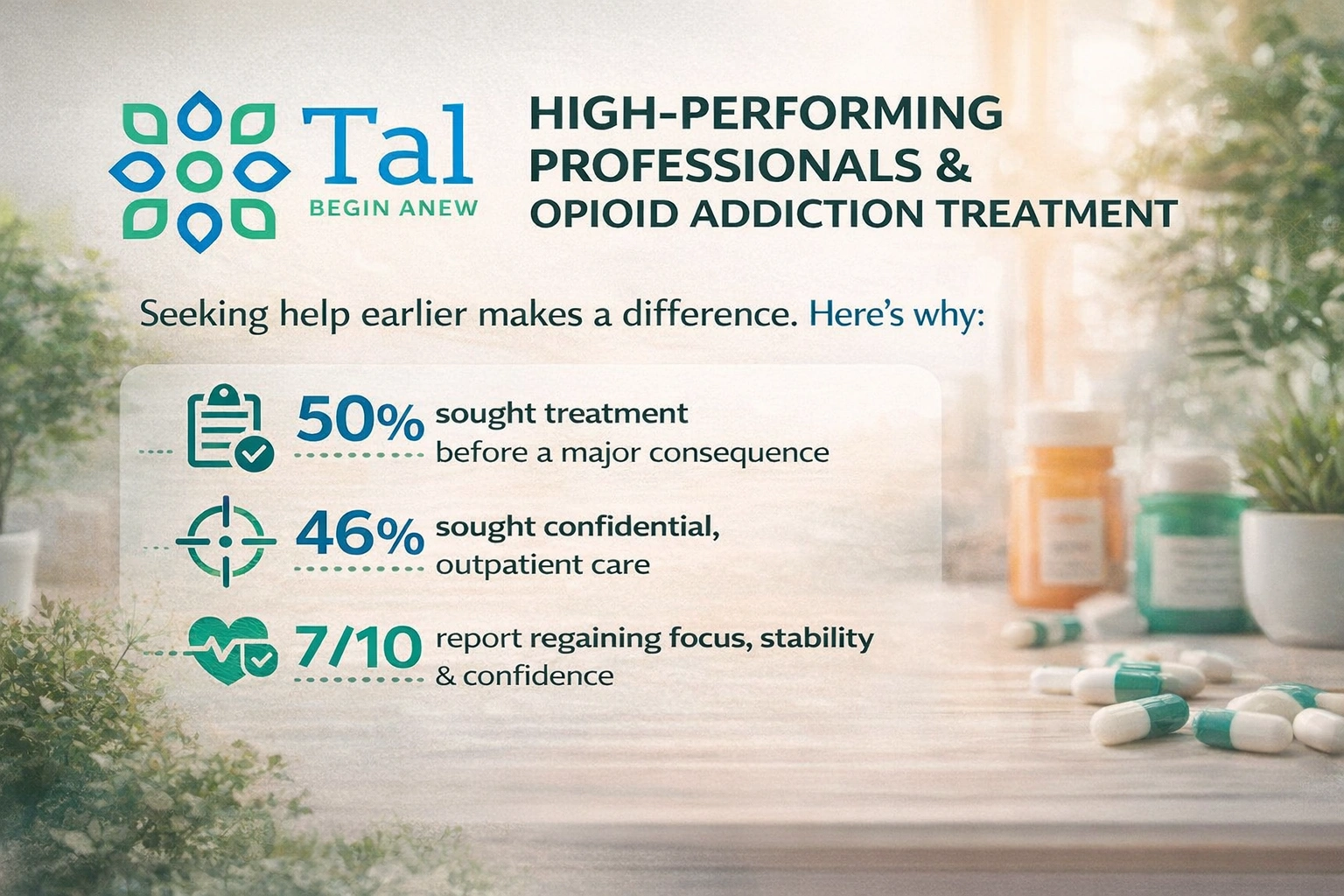
You Don’t Need a Rock Bottom
Many high-functioning individuals delay seeking help because they’re waiting for a dramatic sign.
An arrest.
A lost job.
A health scare.
But the absence of catastrophe does not equal safety.
I often tell my patients: you don’t have to burn your house down to justify installing a fire alarm.
If you’re spending mental energy managing use, that is already a cost.
If you’re afraid to run out, that is already a signal.
If you’ve tried to stop and couldn’t, that is already data.
The earlier you intervene, the less you have to rebuild.
What Changes When You Stop White-Knuckling
Here’s something high-functioning professionals don’t expect:
When the secrecy stops, clarity returns.
Cognitive sharpness improves.
Emotional regulation stabilizes.
Sleep deepens.
Anxiety softens.
The brain has remarkable capacity to recalibrate when it’s no longer chasing or compensating.
I’ve watched executives come back more focused—not less. I’ve seen physicians reconnect with why they entered medicine in the first place. I’ve seen parents show up more present.
Not because treatment made them different.
Because it removed the hidden drain.
The myth says opioids are helping you function.
In reality, they may be narrowing your range.
FAQ: High-Functioning Professionals and Opioid Dependence
How do I know if this is “serious enough” for treatment?
If you’re asking the question repeatedly, it’s worth exploring. Severity isn’t defined by public consequences. It’s defined by impact, tolerance, withdrawal, and psychological reliance. An assessment can clarify where you stand without committing you to anything.
Will seeking help automatically affect my professional license?
Not necessarily. Many professionals seek confidential care without formal reporting requirements, especially when they proactively engage before impairment affects performance. It’s important to speak directly with a treatment provider about your specific situation and profession.
Can I continue working during treatment?
In many cases, yes. Treatment plans can include structured daytime care or multi-day weekly support that allows continued professional engagement. The right level of care depends on medical stability and individual needs.
What if I was originally prescribed opioids?
Dependence can develop even when medication began legitimately. The origin doesn’t determine the current risk. What matters is your current relationship with the substance—tolerance, withdrawal, and loss of control.
I’ve tried cutting back on my own. Why didn’t it stick?
Opioids alter brain chemistry in ways that make self-directed tapering extremely difficult. It’s not about willpower. Clinical support addresses both the physiological dependence and the psychological patterns tied to use.
Is medication-assisted support just “replacing one drug with another”?
That’s a common concern. When used appropriately under medical supervision, certain medications stabilize brain chemistry and reduce cravings without producing the same cycle of intoxication and withdrawal. The goal is stability—not substitution.
What if I’m afraid of who I’ll be without it?
That fear is real. Many high performers worry their edge, confidence, or emotional resilience will disappear. In practice, most rediscover those qualities—without the volatility and secrecy.
A Direct Question
If no one ever found out, would you still want to stop?
Sit with that.
Because often, the primary barrier isn’t uncertainty about the substance. It’s fear of exposure.
If privacy were guaranteed, would you choose relief over maintenance?
As a clinician, I don’t measure readiness by how dramatic your life looks. I measure it by honesty.
You don’t have to hit bottom to deserve stability. You don’t have to fail publicly to justify healing privately.
The longer you rely on control alone, the thinner that margin becomes.
If you’re ready to replace management with actual support, you don’t have to navigate it alone.
Call 216-480-4860 to learn more about our Opioid addiction treatment in Cleveland, Ohio.