
You stopped going. Maybe it was one missed session that turned into two, and then you just… didn’t come back. Or maybe life got heavy, and your brain said, “You can’t deal with this right now.” Whatever the reason, you drifted from your Intensive Outpatient Program—and now you’re wondering if it’s too late to return.
It’s not.
At Tal Behavioral Health in Beachwood, Ohio, we’ve supported many clients who paused treatment, ghosted sessions, or quietly disengaged—and came back. Not because they had to start over. But because they were ready to begin again, this time with more clarity and compassion for themselves.
If you’re thinking about restarting your Intensive Outpatient Program, this guide is for you.
You don’t need to justify your absence. You don’t need to prove your worth. You’re not starting from zero. You’re picking up a thread that never fully left you.
Let’s walk through what that can look like.
Step 1: Release the Shame (Even Just a Little)
Most people who leave treatment mid-way or stop showing up feel something about it—shame, guilt, fear, frustration, or just numbness.
Here’s the truth: pausing treatment doesn’t mean you failed. It means something made it too hard to continue in that moment.
Maybe it was work. Family. Depression. Overwhelm. Maybe you had a relapse, or maybe you just didn’t want to talk anymore.
Whatever it was, we won’t judge it. You shouldn’t either.
One of the biggest emotional barriers to restarting is the internal voice that says, “You let them down. You blew your chance.” That voice is wrong. It’s protective, maybe—but it’s misinformed.
At Tal, we expect that people will leave and return. We keep the door open on purpose.
Step 2: Reach Out—Even If You Don’t Know What to Say
You don’t need a script. You don’t need to prepare a full explanation.
A simple message like:
“Hi, I was in IOP before and I think I want to come back.”
is more than enough.
We know that reaching out after time away can feel awkward or scary. That’s why our first response is always warmth and curiosity, not a checklist.
You won’t get grilled about why you left. Instead, we’ll help you explore what’s going on now and what you need moving forward.
That first phone call or email doesn’t commit you to anything—it just opens the conversation again.
Step 3: Know That You’re Not Starting From Scratch
One of the biggest fears people carry is: “If I come back, I’ll have to redo everything.”
Not true.
If you attended sessions before, we likely still have your records—clinical notes, treatment goals, what was helping, what wasn’t. Your progress didn’t vanish just because you stepped away.
In many cases, we can continue from where you left off, adjusting as needed based on what’s changed since then.
Think of it like resuming a path—not resetting it. You’re not at square one. You’re at the next square.
Even if you feel like you lost ground emotionally, the insight and experience you gained before are still part of you. They don’t disappear.
Step 4: Let the Restart Be Different
Here’s something we talk about often with returning clients: if something didn’t work before, let’s name it and change it.
Was the schedule hard to manage?
Did group therapy feel too intense, or not intense enough?
Was there a mismatch with your therapist?
Did the goals you set no longer feel relevant?
You’re allowed to want different things the second time around.
In fact, that feedback helps us tailor your experience better. IOP isn’t a one-size-fits-all process—and your needs now might look different than when you started the first time.
We can adjust. That’s part of the work.
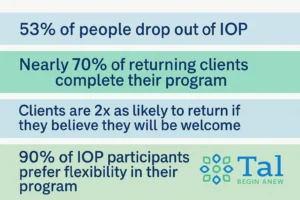
Step 5: Start Where You Are—Not Where You “Should” Be
You don’t need to come back with a story tied up in a bow. You don’t need to be in a “better headspace” or have it all figured out. If anything, returning while you’re unsure or shaky can be one of the most honest things you’ll ever do.
Start where you are.
If you’re angry, bring that.
If you’re scared, bring that.
If you don’t know what to say, say that.
The goal isn’t to return stronger. The goal is to return real.
Our Intensive Outpatient Program was designed to hold people who are in-between. Between collapse and coping. Between wanting help and not being sure if they deserve it.
Spoiler: you do.
Step 6: Expect Support—Not Punishment
You might be imagining a cold welcome. A sit-down talk. An awkward reentry where everyone’s wondering where you’ve been.
That’s not what happens here.
We don’t believe in “starting over as punishment.” We believe in welcoming people back with the dignity and gentleness they deserve.
Our clinicians will meet you with compassion. Your group (if you return to one) will treat you as a peer. And your care plan will reflect where you are now—not where you were when you left.
This isn’t about proving yourself. It’s about reconnecting with your own healing process in a space where it’s safe to be imperfect.
Step 7: Keep It Simple, Keep It Honest
You don’t need to show up five days a week right away (unless that’s what works for you). You don’t need to write a “comeback plan.”
You just need to come back.
Our IOP structure is flexible, and we’ll work with you to find the right fit—whether that means returning full-time, easing back in, or shifting to a different level of care if that’s a better match.
Consistency matters. But so does pacing. Especially when shame and fear have been in the driver’s seat.
Come back slowly, honestly, imperfectly.
We’ll meet you there.
FAQs About Restarting IOP After Leaving
Will I be judged for leaving or not finishing the program?
No. We understand that life, emotions, and circumstances can make treatment hard to stick with. Our response is compassion, not judgment.
Do I need to explain why I left?
Only if you want to. We welcome you back regardless. If sharing helps us support you better, great—but it’s not required.
Will I have to repeat everything?
Not at all. We’ll review your past participation and find the most appropriate way to resume care. You are not starting over from zero.
What if I’m nervous to come back?
That’s completely normal. Many people feel anxiety about reentry. Tell us if you’re nervous—we’ll help you ease in without pressure.
Can I switch therapists or adjust my schedule?
Absolutely. If something didn’t work before, we want to know so we can make changes that support your success now.
What if I relapsed while I was gone?
You’re still welcome. We’ll support you with care, not criticism. Relapse is part of many people’s healing journeys—it doesn’t cancel your progress.
You’re Still Welcome
Call (216) 480-4860 to reconnect with our Intensive Outpatient Program in Beachwood, Ohio. You don’t have to explain. You just have to begin again—and we’ll be here when you do.